Category: envirOnment


nyrb032212

“Why the Global Warming Skeptics Are Wrong”

William D. Nordhaus is Sterling Professor of Economics at Yale. (March 2012)

His evidence based article is freely available below and above at

the New York Review of Books

www.nybooks.com/articles/archives/2012/mar/22/why-global-warming-skeptics-are-wrong/

julielima

Australia’s status as a climate wrecker at last years UN climate meeting in Warsaw (COP19) is deteriorating even further this week, with the gulf between the Abbott government’s actions on climate change and its rhetoric growing wider and more confusing by the day.

The Government was planning to not send a minister to the latest climate meeting in Lima (COP20), until Foreign Minister Julie Bishop forced the issue in cabinet. Her request was approved on the proviso Trade Minister Andrew Robb “chaperoned” the trip due to “the significant economic and investment matters involved”. This statement is totally at odds with the Government’s fight to stop climate change being discussed at the G20 given it was an “economic meeting”. Allegedly leaked talking points from the Prime Minister’s office show that it is spinning its grudging allowance of Bishop to attend COP20 with Robb in tow as a sign of its “commitment to dealing with climate change”, but the attendance of the Foreign Affairs and Trade ministers instead of the Environmental Minister has also been dubbed an attempt to set up the climate talks to fail. Either way, the move appears to again be for show, not action, with the Government refusing to contribute to the Green Climate Fund when even conservative buddies Canada and New Zealand are.

Australia has already won two Fossil of the Day awards, and with it being named the worst performing industrial economy on climate change and Julie Bishop talking down unprecedented moves by China to cap coal use and emissions as “business as usual to 2030″, it is quite likely it could see a repeat of the five fossil awards it picked up at COP19.

firecircle

The UN Climate Talks, otherwise referred to as COP 20, begin next week in Lima, Peru at a time when climate change has rocketed back to the top of the global political agenda. The Lima talks are an opportunity for governments to harness momentum that has been growing around the world for months and begin taking internationally coordinated action to address the global climate change crisis. In Lima, governments can move forward on an international action plan to be finalized in Paris at the end of next year, which aims to accelerate the ongoing transition away from dirty fossil fuels to 100% renewable energy.

The foundation of any agreement in Paris will be built in Lima. That foundation includes getting nations to begin crafting Intended Nationally Determined Contributions (INDCs), where countries will offer their plans for how to slash global carbon emissions so that the world’s warming is contained to no more than 2degC. The deadline for the INDC offers is March 2015, making Lima an opportunity for governments to put the finishing touches on what these commitments should contain, how long they should last, and how they should be presented.

COP 20 is also an opportunity for governments to continue supporting the Green Climate Fund, which now has commitments for up to 9.6 billion in funding, but has an investment target of $100 billion by 2020. Politically, COP 20 comes at a pivotal time. In September, hundreds of thousands of individuals from New York to Mumbai took part in the People’s Climate March, where the demand for governments to act on climate was made at historic levels. Days later, the march was referenced by several leaders, including Barack Obama and Ban Ki-moon as a reason to act.

Coverage…


Stand with the Alyawarr and Anmatyerr Peoples and tell the government not to abandon homelands.
http://www.amnesty.org.au/homelands

The Government has no right to abandon Aboriginal people for choosing to live on their homelands.

OCCUPY.com ::: LATEST :::

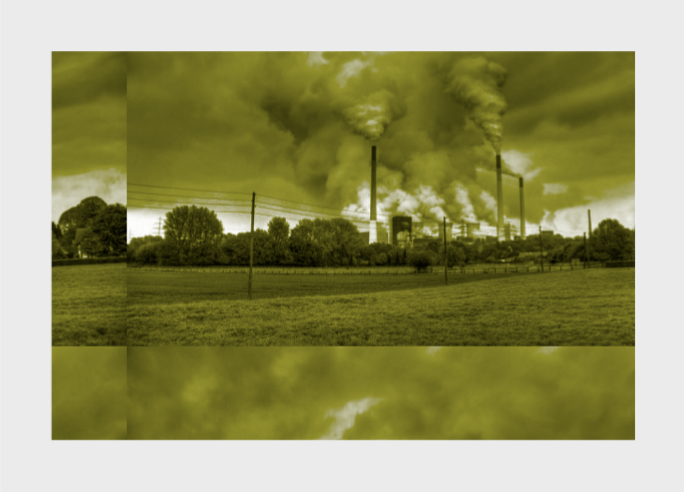
poluutionchimn

The world needs to take immediate action towards a complete phase out of fossil fuels and force global greenhouse gas emissions onto a downward trajectory. This is the clear message from the United Nations Environment Programme in its latest Emissions Gap Report. Launched today in Washington DC, the report confirms there is no time to waste if the world is to stay under the agreed red line of 2DegC average warming. The good news is that more and more countries are already waking up to this – forced to face facts by the recent government-endorsed IPCC report confirming that carbon emissions will have to be brought to zero.

The US, China and the EU have all recently showed climate action leadership: the EU with its 2030 climate and energy package; the US with its pledge to double the pace at which it will reduce carbon pollution; and China with plans to slow, peak and then reverse the course of its carbon emissions. But today’s report shows that all countries need to take action, and that deeper and faster emissions cuts will reduce climate risks and the costs of action.

Now is the moment – in the run up to the UN climate summit in Lima, Peru – for coalobsessed blockers like Australia to show that they too wish to be on the right side of history.

tonyarse

As “Queensland premier tells Obama he is ‘solid’ on protecting Great Barrier Reef” (the Guardian), here’s a reality check…

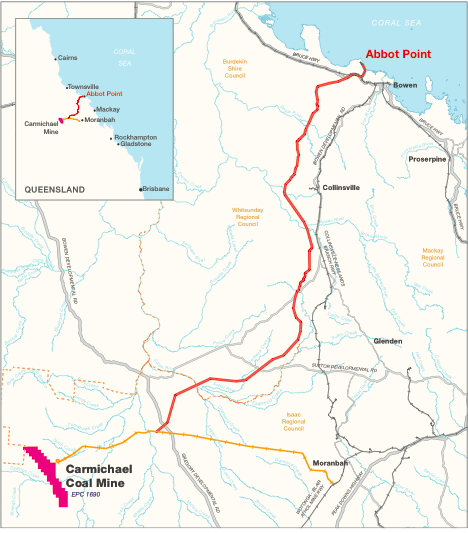
The Abbot Point dredging project, recently approved by Australian environment minister, Greg Hunt, will allow India’s Adani Enterprises to build Australia’s biggest coal mine in the Galilee Basin in central Queensland, and dredge, to allow massive coal ships to access their proposed new shipping terminal at Abbot Point…to send coal overseas.

@ the interpretOr, we’re looking at the Indian Government’s recent report on Adani’s existing Mundra port operations that found incontrovertible evidence of:

destruction of mangroves,

blocking of creeks and…

…non-compliance of other clearance conditions.

The reporting committee, headed by Sunita Narain of Centre for Science and Environment, was set up by the Union Ministry of Environment and Forests (Government of india), to inspect ship-breaking facility of M/s Adani Port and SEZ Limited near Mundra West Port in Gujarat’s Kutch district. The committee submitted its report on April 18, 2013 and it can be downloaded in pdf by clicking here :::

Subsequently, on July 29, 2013 a public hearing for the project was held where people from four project-affected villages and nearby locations attended the public hearing at Tunda village in Mundra taluka and posed questions about the project and its impact on the environment. But the public hearing ended without the company being able to give comprehensive answers to the queries raised by the project-affected people, report Down To Earth (DTE)the Indian science and environment fortnightly:

Using remote sensing technology, the committee has found that that over the last decade, 75 hectares of mangroves have been destroyed in Bocha Island, a conservation zone. Satellite imagery indicates deterioration and loss of creeks near the proposed North Port due to construction activities. The company has also neglected to inventory its utilisation and disposal of fly ash, and has not ensured that storage tanks, seawater inlets, and discharge outlets are lined to prevent increase in salinity and contamination of water. The report also states that the Adani group has been less than serious about reporting on compliance with the conditions set at the time of clearance. In many cases, non-compliance with reporting conditions has been observed.

The committee also noted that there have been instances to circumvent statutory procedures by using different agencies, at the Centre and state, for obtaining clearances for the same project. The public hearing procedure, which is a critical part of project clearance and helps to understand and mitigate the concerns of local people, has also been bypassed on one pretext or another. The fisher community, which depends on the coasts for their livelihood, is the worst hit by the changes brought on by land acquisition and construction for the project. 

munda

(Adani project in Mundra has violated environmental norms: MoEF committee report)

murdabb

The Australian government took its strategy of fighting the future to a whole new level this week, with ministers lining up to attack the ANU’s decision to abandon many of its fossil fuel investments, and Prime Minister Tony Abbott taking the coal industry’s PR line to claim that coal is “good for humanity” and has a “bright future” despite overwhelming evidence to the contrary.

We know that we cannot burn the majority of our fossil fuel reserves, the international community is preparing for a low carbon future, and it costs more to mine and ship Australian coal than it can be sold for. Couple this with China imposing a new 6 per cent coal import tariff, its steel industry being close to peak production, and forecasters saying the decline in prices will continue as China moves away from imported coal; it’s clear to see why the Abbott government’s vocal protection and support for coal has been dubbed a “suicide strategy”.

2071-600x337

Climate change may not be the most obvious subject for a play, but theatregoers in London have been turning up in droves to see scientist Chris Rapley give an impressive account of the subject.

The 75-minute play, illustrated with swirling video images, manages to captivate audiences just with the power of the bare, stripped down facts of science, and without relying on the usual catastrophe imagery and doom and gloom language. “2071” discusses the consequences of mankind’s dependence on fossil fuels – how 90 per cent of the world’s glaciers and ice caps are retreating and raising sea levels. Soaring greenhouse gas levels are affecting the climatic equilibrium which is the basis of modern civilisation, says Rapley, highlighting a global temperature-rise of 2DegC as a crucial “guard rail”.

To avoid such levels of warming, “the greatest collective action in history” is required. But audiences are left with hope that with energy efficiency and a greater use of renewables such as wind farms and solar power, mankind can start to tip the balance in a better direction.


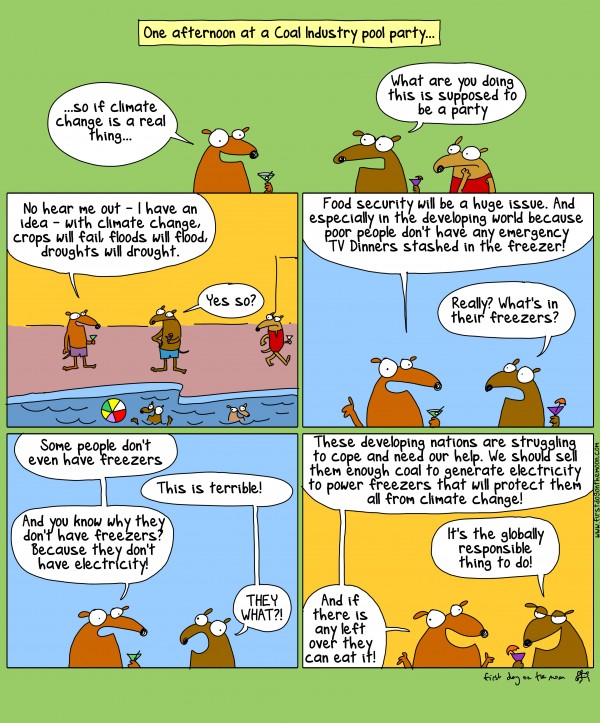
CoalIndustryPoolparty-600x723

CreativeCommons

While the Intergovernmental Panel on Climate Change has warned that the world must phase out up to 70 per cent of fossil fuels by 2050, Australia and other G20 nations continue to pay lip service to a clean energy transition by spending billions subsidising new fossil fuel exploration activities.

The ‘age of entitlement’ isn’t over for those filthy fossil corporations, and what’s more, we the people are subsidising them…

…A new report from Oil Change International (US) and the Overseas Development Institute (UK) has highlighted the perverse incentives governments are giving to fossil fuel companies, with G20 governments spending $100 billion (USD$88 billion) a year searching for new oil, gas, and coal reserves. The US leads the way with $5.9 billion (USD$5.1bn), but Australia’s $4 billion (USD $3.5bn) puts it a close second, and ahead of the $2.7 billion (USD $2.4bn) Russia spends.

Globally, governments subsidise fossil fuels to the tune of AUD$887 billion a year, while spending, by comparison, a tiny AUD$117bn (USD$101 bn) on renewable energy…

Such skewed support for fossil fuels is a direct threat to the global carbon budget, which states that two thirds of known fossil fuel reserves have to stay in the ground if the world is to keep average warming to 2DegC. The report urges G20 leaders to phase out these dirty, inefficient exploration subsidies as a first step to meeting existing commitments to avoid harmful climate change.

…but don’t take our word for it; here are a selection of tools and resources :::

tonhote

Australia is the worst polluter per capita in the Organisation for Economic Co-operation and Development (OECD), (and that is not counting the significant impact of its coal exports on air pollution and global warming, (click logo below for OECD’s spreadsheet):

logooecd_en

The industry and the government are ignoring climate science, and would rather pretend that coal is “good for humanity”, and sell as much of it as possible to the developing world under the guise of ending “energy poverty” when they are really only interested in keeping coal profits alive in a dying market. In fact, the World Bank has called climate change “a fundamental threat to development in our lifetime”, saying that “If we do not confront climate change, we will not end poverty.” Scientists warn that the world needs to phase out coal in the electricity sector altogether by 2050 to keep warming below 2DegC.

coal

With ‘leaders’ (sic), puppets and stooges meeting for the G20 meeting in Brisbane this week, the role of coal in development and poverty alleviation is being relentlessly talked up, with Australian politicians from the Prime Minister down running coal industry PR lines.

However, while Tony Abbott insists that coal is the “foundation of prosperity”, a new report from The Australia Institute shows that while the industry talks a big game on fighting poverty, it doesn’t even use coal to help the energy poor in the developing world.

The report All talk, no action: the coal industry and energy poverty finds that on the few occasions coal companies have spent money to help the energy-poor, they ironically tended to use distributed, off-grid renewables or hydro power at best. At worst, G20 sponsor Peabody Coal literally did nothing to help the energy poor other than push a website and PR campaign designed to influence public policy and opinion.

21 Oct 2014 | Christine Milne

This is a significant moment for Australia as we remember Gough Whitlam and his momentous contribution to our nation. He was Prime Minister for only three years but he swept all before him. We all mourn his passing and celebrate his great life.

He was a larger than life figure whose leadership profoundly changed the nation for the better, forever.

Mr Whitlam made us a progressive nation and put us on the global map. After decades of conservative government, in came Gough.

His passion for social justice, education and the arts was legendary. He improved Australia’s humanitarian and cultural standing in the world by ratifying the Human Rights Convention and the World Heritage Convention.

Mr Whitlam was a champion for the environment, establishing the National Parks and Wildlife Service and protecting the Great Barrier Reef.

I remember it keenly, being at university at the time, with so many young people who had lived in fear of being ‘called up’ that he ended conscription and completed the withdrawal of troops from Vietnam.

Mr Whitlam ended university fees and brought about federal funding on a needs basis for public schools. For the first time it didn’t matter how much your family earned, you could access quality education. He brought the Commonwealth into housing and health for the first time.

His significant work on land rights and establishing the Department of Aboriginal Affairs set us on the path to further recognition of Australia’s first people.

Internationally, his recognition of China and his visit there was critical to the redefinition of Australia as an Asian nation.

Rest in peace Gough Whitlam. On behalf of the Australian Greens I send our deepest thoughts, sympathies and thanks to the Whitlam family and to all those who knew and loved him.

Live after the Man Booker 2014 awards ceremony Kirsty Wark (BBC NewsNight) talks to the winner, Australian Richard Flanagan who has scooped the £50,000 prize for his wartime novel, The Narrow Road to the Deep North.

Here @ the interpretOr, we reckon that it’s puffed-up, greedy windbags like Joe Hockey, rather than renewable energy, that are the real blot on the landscape…

ABC News, 17 SEPT, 2014:

Federal Treasurer Joe Hockey has made more critical comments about the way wind farms look, describing them as “appalling”.

Mr Hockey said renewable energy was “hugely important” but believed wind turbines were ruining beautiful bits of the Australian landscape.

According to Scott Ludlam, an Australian Greens Senator for Western Australia, the Abbott Government has slashed over half a billion dollars from programs designed to address Australia’s housing affordability crisis…

IF YOU RENT
12,000 affordable rentals won’t be built because Abbott scrapped the National Rental Affordability Scheme.

FIRST HOMEBUYERS
The savings scheme designed to help people save a deposit for their first home has been axed.

SENIORS
A pilot program designed to help seniors to downsize into more appropriate housing has been cancelled.

IF YOU FIND YOURSELF HOMELESS
Homelessness services are already stretched thin and their funding beyond 2015 is uncertain. $44 million for new shelters and crisis accomodation facilities has also been cut.

These short sighted cuts will do little to ease the pressure on Australians who are already doing it tough. Nor will it prompt the investment in diverse affordable new housing that Australia needs. This will only increase the number of people experiencing homelessness. Tony Abbott has made it very clear that he doesn’t care about Australia’s who are doing it tough. His cuts to those who are most vulnerable, while letting big business get a free ride, are unconscionable.

THE GREENS WILL FIGHT THESE BUDGET ATTACKS. 

Tell us your story or sign up to find out more about how you can join the campaign against Tony Abbott’s cruel cuts.

You can also check out our comprehensive plan to address Australia’s housing affordability crisis.

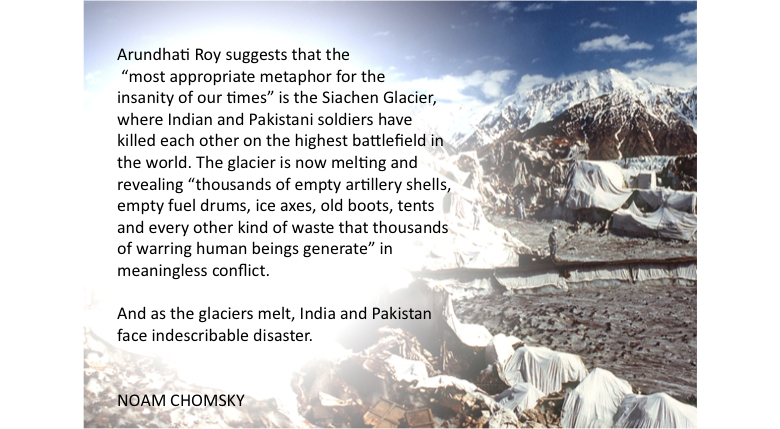
glac

03 Sep 2014 | Scott Ludlam
Nuclear

Confirmation that the Australian Government has suspended potential uranium sales to the Russian Federation has been welcomed by the Greens, after questions placed by Adam Bandt MP in the House and Senator Scott Ludlam in the Senate.

“The Australian Greens have argued that uranium sales to the Russian Federation should never have been contemplated in the first place,” Senator Ludlam said.

“President Putin’s implied threat of nuclear escalation last week, saying, “I want to remind you that Russia is one of the leading nuclear powers,” underlies the risks that Australia faces in fuelling the nuclear industry in Russia and elsewhere.

“With heightened tensions resulting from Russia’s military actions in eastern Ukraine, it is entirely appropriate for the Australian Government to prevent Australian uranium from being shipped to the Russian Federation,” said Senator Ludlam.

“The Greens believe we should revert to an outright ban and caution Prime Minister Abbott against opening a new line of atomic instability with India, which has refused to sign up to international legal agreements on non-proliferation and disarmament.”

George Monbiot’s SPERI Annual Lecture, hosted by the Sheffield Political Economy Research Institute at the University of Sheffield, 2014.

‘…If we surrender to the financial agenda and say, “This market-led neoliberalism thing is the way forward,” then we shift social values. Environmentalists are among the last lines of defence against the gradual societal shift towards extrinsic values. If we don’t stand up and say, “We do not share those values, our values are intrinsic values. We care about people. We care about the natural world. We are embedded in our communities and the people around us and we want to protect them, not just ourselves. We are not going to be selfish. This isn’t about money”, who else is going to do it?’

AMY GOODMAN: From disease to addiction, parenting to attention deficit disorder, Canadian physician and bestselling author Gabor Maté’s work focuses on the centrality of early childhood experiences to the development of the brain, and how those experiences can impact everything from behavioral patterns to physical and mental illness. While the relationship between emotional stress and disease, and mental and physical health more broadly, is often considered controversial within medical orthodoxy, Dr. Maté argues too many doctors seem to have forgotten what was once a commonplace assumption, that emotions are deeply implicated in both the development of illness, addictions and disorders, and in their healing.

Dr. Maté is the bestselling author of four books: When the Body Says No: Understanding the Stress-Disease ConnectionScattered: How Attention Deficit Disorder Originates and What You Can Do about It; and, with Dr. Gordon Neufeld,Hold on to Your Kids: Why Parents Need to Matter More than Peers; his latest is called In the Realm of Hungry Ghosts: Close Encounters with Addiction.

In our first conversation, Dr. Maté talked about his work as the staff physician at the Portland Hotel in Vancouver, Canada, a residence and harm reduction facility in Downtown Eastside, a neighborhood with one the densest concentrations of drug addicts in North America. The Portland hosts the only legal injection site in North America, a center that’s come under fire from Canada’s Conservative government…


DR. GABOR MATÉ: When people are mistreated, stressed or abused, their brains don’t develop the way they ought to. It’s that simple. And unfortunately, my profession, the medical profession, puts all the emphasis on genetics rather than on the environment, which, of course, is a simple explanation. It also takes everybody off the hook.

AMY GOODMAN: What do you mean, it takes people off the hook?

DR. GABOR MATÉ: Well, if people’s behaviors and dysfunctions are regulated, controlled and determined by genes, we don’t have to look at child welfare policies, we don’t have to look at the kind of support that we give to pregnant women, we don’t have to look at the kind of non-support that we give to families, so that, you know, most children in North America now have to be away from their parents from an early age on because of economic considerations. And especially in the States, because of the welfare laws, women are forced to go find low-paying jobs far away from home, often single women, and not see their kids for most of the day. Under those conditions, kids’ brains don’t develop the way they need to…

::::::::


“…if you look at the preponderance of ADD in North America now and the three millions of kids in the States that are on stimulant medication and the half-a-million who are on anti-psychotics, what they’re really exhibiting is the effects of extreme stress, increasing stress in our society, on the parenting environment. Not bad parenting. Extremely stressed parenting, because of social and economic conditions. And that’s why we’re seeing such a preponderance…”

  ::::click here for piece in full @ AlterNet:::: 


Greens believe Western Australians deserve to know what their political leaders are proposing in the face of falling iron ore prices and job losses in the construction industry.

The Greens Energy2029 plan forecasts up to 26,000 construction jobs in a mature renewable energy market. Senator Scott Ludlam said continued investment in the renewable energy sector would secure thousands of jobs, at risk if the Renewable Energy Target were to be wound back…

“We can also create jobs in the timber and manufacturing industries by developing a pre-fabricated housing sector here in WA. We have the plantation timber, we have the need with 45,800 people on housing waiting lists, and we can take advantage of new innovations in modular housing.

“The Greens will support small business by reducing the tax rate, and we will continue to fight for the rollout of an end-to-end fibre to the premise broadband network that will underpin our strong services sector.”

“I would be delighted to debate these issues with other candidates in this by-election,” Senator Ludlam said.

:::: click on through to Senator Ludlam’s homepage ::::


“Terrorism, epidemics, poverty, the proliferation of weapons of mass destruction: all challenges that know no borders…

…The reality is that climate change ranks right up there with every single one of them.”

John Kerry, United States Secretary of State, 17 Feb 2014.


The Abbot Point dredging project, recently approved by Australian environment minister, Greg Hunt, will allow India’s Adani Enterprises to build Australia’s biggest coal mine in the Galilee Basin in central Queensland, and dredge to allow massive coal ships to access their proposed new shipping terminal at Abbot Point…to send their coal overseas.

@ the interpretOr, we’re looking at the Indian Government’s recent report on Adani’s existing Mundra port operations that found incontrovertible evidence of:

destruction of mangroves,

blocking of creeks and…

…non-compliance of other clearance conditions.

The reporting committee, headed by Sunita Narain of Centre for Science and Environment, was set up by the Union Ministry of Environment and Forests (Government of india), to inspect ship-breaking facility of M/s Adani Port and SEZ Limited near Mundra West Port in Gujarat’s Kutch district. The committee submitted its report on April 18, 2013 and it can be downloaded in pdf by clicking here :::

Subsequently, on July 29, 2013 a public hearing for the project was held where people from four project-affected villages and nearby locations attended the public hearing at Tunda village in Mundra taluka and posed questions about the project and its impact on the environment. But the public hearing ended without the company being able to give comprehensive answers to the queries raised by the project-affected people, report Down To Earth (DTE)the Indian science and environment fortnightly:

Using remote sensing technology, the committee has found that that over the last decade, 75 hectares of mangroves have been destroyed in Bocha Island, a conservation zone. Satellite imagery indicates deterioration and loss of creeks near the proposed North Port due to construction activities. The company has also neglected to inventory its utilisation and disposal of fly ash, and has not ensured that storage tanks, seawater inlets, and discharge outlets are lined to prevent increase in salinity and contamination of water. The report also states that the Adani group has been less than serious about reporting on compliance with the conditions set at the time of clearance. In many cases, non-compliance with reporting conditions has been observed.

The committee also noted that there have been instances to circumvent statutory procedures by using different agencies, at the Centre and state, for obtaining clearances for the same project. The public hearing procedure, which is a critical part of project clearance and helps to understand and mitigate the concerns of local people, has also been bypassed on one pretext or another. The fisher community, which depends on the coasts for their livelihood, is the worst hit by the changes brought on by land acquisition and construction for the project. 

munda

(Adani project in Mundra has violated environmental norms: MoEF committee report)

Association of Marine Park Tour Operators president Colin McKenzie, the peak industry lobby group covering tourism in the World Heritage-listed reef region, accused the Great Barrier Reef Marine Park Authority of pandering to politicians.

“Leadership of the Authority needs to be replaced. If they won’t do their job of preserving the environment out there then they should have people there that will,” he told Fairfax radio.

“These guys are just pandering to the politicians. The GBRMPA should do what it is actually being paid to do — which is provide for the protection and conservation of the reef.”

more @ www.agencefrancepresse.com/ 

Tony Abbott wants to shred the landmark agreement to protect Tasmania’s forests, demanding that the World Heritage Committee strip this ecological oasis of protection.

Here’s a reflection from the late, great Krishnamurti on losing our relationship with nature… 

The death of a tree is beautiful in its ending, unlike man’s. A dead tree in the desert, stripped of its bark, polished by the sun and the wind, all its naked branches open to the heavens, is a wondrous sight. A great redwood, many, many hundreds of years old, is cut down in a few minutes to make fences, seats, and build houses or enrich the soil in the garden. The marvellous giant is gone. Man is pushing deeper and deeper into the forests, destroying them for pasture and houses. The wilds are disappearing. There is a valley, whose surrounding hills are perhaps the oldest on earth, where cheetahs, bears and the deer one once saw have entirely disappeared, for man is everywhere. The beauty of the earth is slowly being destroyed and polluted. Cars and tall buildings are appearing in the most unexpected places. When you lose your relationship with nature and the vast heavens, you lose your relationship with man.

If you feel like telling Abbott to take a hike, why not sign the petition @ SumOfUs:

http://action.sumofus.org/a/tasmania-forests-abbott/?sub=taf

As a sweltering Australia struggles to contain nationwide bushfires, two new reports from reputable US organizations published in Bloomberg news.com, signal further alarming developments for the country to cope with.

Bloomberg reports that “Dangerous rises in the sea level or heat waves that kill crops can arrive quickly and leave little time to put preventative measures in place, according to a study from the National Research Council, a group of scientists providing information for U.S. government decision-makers.”

“The report — one of two issued today on climate change — calls for an early warning system to monitor climate conditions and improved models for predicting changes that impact the way people live. The alerts could be modeled on such programs as the National Integrated Drought Information System created by Congress in 2006 or the U.S. Agency for International Development’s Famine Early Warning System Network.

“In a separate report today, James Hansen, who warned of the dangers of global warming as early as 1988, said a United Nations-endorsed target of capping global warming is too high and will ensure future generations suffer “irreparable harm.”

Even limiting warming to 2 degrees Celsius (3.6 degrees Fahrenheit) above pre-industrial times would submerge coastlines, cause the mass extinction of species and trigger extreme weather, according to Hansen, former director of the NASA Goddard Institute for Space Studies and co-author of the report published today in the journal PLOS One.

“Two degrees Celsius warming above pre-industrial, which would mean about 1 degree Celsius warming above the present, creates a significantly different planet with enormous consequences, including eventually the un-inhabitability of coastal cities,” Hansen, adjunct professor at New York’s Columbia University’s Earth Institute, said at a briefing. “There’s no recognition of this in government policies.”

Australians have to sit out another 3 years of a government hell bent on ignoring these massive impacts on our climate our ecosystems and our coastal cities. Prime Minister Abbott studiously ignores the current climate extremes that are causing death and destruction in every state. To do so for much longer will ensure the death of his political party in the medium term.

Read more at.  http://www.bloomberg.com/news/2013-12-03/sea-level-rise-too-fast-to-reverse-climate-change-study.html?cmpid=otbrn.sustain.story

Humanity at the Crossroads by Jim S…

In the furore surrounding the Edward Snowden and Wiki leaks revelations it is easy not to notice the connection to three other huge issues that are bearing down on humanity like the Four Horsemen of the Apocalypse.

These issues threaten every system that currently supports human existence and happiness on this planet.

The first system is democratic governance, the system of government where power is placed in the citizens to elect their peers to sit in a house of representatives to make rules that are in the best interest of the people that is government of the people by the people.

This is no longer the case in most Western democracies. Many Governments represent sectional interests who in turn fund their election and campaigns. These sectional interests undermine and take over the role and functions of government. Furthermore government departments have modelled themselves on corporations because they use corporate advisors to shape the management and ethos of government departments.

The second issue is the market economy that was designed as utilitarian system to benefit the whole of society by making finance available to build businesses and to provide fairly paid jobs. However, it has been undermined and has lost all sense of equity and balance. Furthermore the lack of sensible regulation has changed its main purpose to speculation with little regard for the production and sale of goods.

Having more and more wealth in fewer and fewer hands is bad for the economy overall and although the economic rise of Asia has seen many more people move from poverty to a middle class lifestyle, the trend in older market economies to less equality of wealth is accelerating.

The third problem area is the growing imbalance between the wealth and power between nation states and giant corporations. Corporations like the giant banks are seen as so integral to the economic basis of national economies they cannot be allowed to fail. These corporations however have no such loyalty to the governments that prop them up with taxpayer’s money and bank guarantees. They quite happily campaign against the same governments and against the interest of the people.

The most significant corporate sector in this power imbalance is the corporate media which the Leveson inquiry in the United Kingdom found that

…the evidence clearly demonstrates that, over the last 30-35 years and  probably much longer, the political parties of UK national Government and of UK official. Opposition, have had or developed too close a relationship with the press in a way which has not been in the public interest.

The inquiry heard leading political witnesses say they feared the Murdoch press and courted its favour and that they were heavily criticised and crushed by his papers if Rupert Murdoch felt he could get a better deal from another party or politician.

Finally the most important issue, that of the rapid destruction of the earth’s biosphere and ecosystems has reached the point of mass extinction of species of plants and animals with no strong action or even agreement for action by national governments. Again this is because of dishonest campaigns by giant corporations using anti-environmental front groups to create division and confusion in the public mind about the reality and cost of climate change and its amelioration.

So what has this to do with the revelations of Edward Snowden?

Edward Snowden worked for a private corporation that spied on the online interactions of almost everyone on the planet. He was a just one part of a massive intrusive operation carried out supposedly for the USA Government to keep all Americans safe from terrorism “in the war against terrorism”.

In fact much of this information was being used against law abiding citizens and for the benefit of US corporations. An example of this was the spying on the Occupy movement who were peacefully protesting against the powerful corporations whose grubby share dealing bought about the world financial crisis and who wilfully mislead investors to induce them to buy worthless stock.

That the Occupy movement was spied on by the government may be excusable but their passing on of the information to the bankers and traders was not. This is and was an elected Government acting against the 99% of the people on behalf of the wealthy corporate 1%.

Of the incidents so far revealed, the most shocking instance of a government spying on the CMD (Campaign for Media and Democracy) an organisation that is fighting against the corporate takeover of government in the USA. This takeover has been done through ALEC ( the American Legislative Exchange Committee). ALEC consists of a group of large companies most of which are desperate to replace laws and regulations that might reduce their profits such as environmental protection, anti-smoking and health, workplace safety and gun laws.

ALEC also recruits and funds state and federal politicians to help them promulgate model laws which they then lobby heavily to push through state and federal legislatures.

After a recent rally protesting outside an ARLEC conference the CMD discovered that state based federal anti-terrorist agencies spied on the protest movement and passed on this information to ALEC. To make matters worse it was found that the uniformed police who had violently assaulted protest leaders had been off duty and were being paid by ALEC.

What this clearly signifies is that the US Government and many US State Governments are sharing security information and working with large corporations against peaceful community organisations and colluding in passing legislation that is against the interest of the American people.

How far this has spread into other Western democracies is not yet clear but there is evidence that police in the United Kingdom were being paid by the Murdoch press and this is possibly true of Australia where it has been reported that the Murdoch press reporter was tipped off about an impending anti- terrorist raid by a security officer.

What is most important about Snowden, Assange, Manning and the CMD,  is not that they made public the invasive level of security in the USA and elsewhere, but that Governments are using the information against ordinary law abiding citizens and that the security apparatus is not only being operated by private companies but it is sharing that information with large corporations often against the public interest.

Citizens, the corporate state has arrived. It is in our bedrooms and on our private communication systems and you and democracy are its enemy.

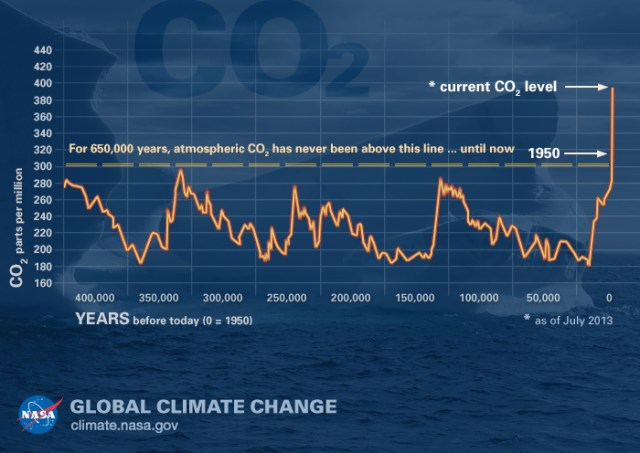
24_g-co2-l

“Every atom in your body came from a star that exploded. And the atoms in your left hand probably came from a different star than your right hand. It really is the most poetic thing I know about physics. You are all stardust. You couldn’t be here if stars hadn’t exploded. Because the elements, the carbon, nitrogen, oxygen, iron, all the things that matter for evolution weren’t created at the beginning of time. They were created in the nuclear furnaces of stars. And the only way they could get into your body is if the stars were kind enough to explode. So forget Jesus. The stars died so you could be here today.”

-Lawrence M. Krauss

Lawrence Maxwell Krauss is an American theoretical physicist and cosmologist who is Foundation Professor of the School of Earth and Space Exploration at Arizona State University and director of its Origins Project.

A Canadian court Tuesday granted Ecuadorean farmers and fishermen the right to attempt to seize the Canadian assets of Chevron due to a 2011 decision in an Ecuadorean court that found the company liable for nearly three decades of soil and water pollution and the ruined health and livelihoods of people living in nearby areas of the Amazon rainforest.

In the intervening period, the victims have been trying to collect roughly $18 billion in environmental damages. Chevron responded by filing its own lawsuit that argued the verdict was won through fabrication of evidence and bribery.

Paul Barrett of Bloomberg Businessweek talks with “Democracy Now!” on Friday about how oil corporations including Chevron and BP are fighting lawsuits brought against them by attacking the lawyers handling the cases.

—Posted by Alexander Reed Kelly @ truthdig.com 

nofracking
Written by  on December 18, 2013

The Water Corporation have made a strong statement against Fracking, calling for a ban in areas where it may affect drinking water sources.

“WA’s monopoly water provider has called for the gas drilling technique known as fracking to be banned in areas where it affects drinking water sources, saying contamination risks are unacceptable. The Water Corporation told an Upper House inquiry into the “implications” of fracking in WA that it opposed the practice in drinking water areas. The State-owned utility unsuccessfully asked for its comments to be kept confidential.”
“Water Corporation does not endorse any decision to increase public health risks in drinking water source areas as it runs counter with the fundamental principles of drinking water management,” it said.

 “Such a decision will come at a huge social, financial and ecological cost to the community.”

Screen-Shot-2013-11-26-at-12.18.03-PM

Coal mining in Australia looks to be increasingly disconnected from reality of late. The industry’s push to massively expand operations in the Galilee basin continues to enjoy strong support from State and Federal Coalition governments, of both political persuasions. This is at a time when both the international market and domestic investment are slumping, creating losses. A new Greenpeace report has warned that Indian conglomerate Adani’s Galilee project is “uncommercial“, and as global climate action grows, the divestment movement gathers pace, and the realities of unburnable carbon loom increasingly large in the minds of investors, the future for coal is anything but rosy. As many people have predicted – the Galilee basin could become a wasteland of stranded assets.

Ian Dunlop’stilt at the board of BHP Billiton has highlighted the risk ignoring the climate imperative poses, kick starting a discussion about BHP Billiton’s contradictory claims of climate leadership while supporting the abolishment of carbon pricing. Cognitive dissonance in the industry was again demonstrated on Monday, when billionaire mining magnate Gina Rinehart launched “National Mining and Related Industries Day”, celebrating “an industry group that is too often shy about speaking of its efforts and contributions”. Given its vast advertising spend, its fondness for highly paid lobbyists and its expensive and brutal campaign against the mining tax, the thought of the industry being a wallflower is as believable as the World Coal Association’s claim that “high-efficiency coal” is a low-emissions technology.

The coal industry appears to be increasingly delusional about its future, pushing for expansion as investment slows, pretending to acknowledge the climate imperative while supporting the repeal of carbon pricing, and claiming it is shyand green when it is anything but. Despite State and Federal government enthusiasm to expand coal mining and the industry’s willingness to make increasingly risky bets, there is no future for growing coal use in a world struggling to stay under 2DegC of global warming. The vast majority of Australia’s coal reserves – particularly in the Galilee basin – must stay in the ground if the world is to have any hope of addressing climate change.

Tools and resources

Australia’s international reputation on climate action is rapidly deteriorating, as not only has it been dubbed a “willful” wrecking ball at the UNFCCC COP19 negotiations, but new reports show that it has both slid to the bottom of international rankings of carbon emission reduction efforts, and become the number one emitter per capita among developed nations. The Global Carbon Project shows that Australia is failing to reduce carbon emissions at a rate comparable to the US or the European Union, and that its emissions remain consistent with the levels seen over the past decade. Despite the increasingly woeful performance, Australia has joined Canada todeny developing nations further climate funding.

  • After bringing a “hard-line ideological agenda” and wrecking ball tactics to COP19, Australia is now being seen as an “anti-climate” nation, actively working against a constructive outcome at the UNFCCC negotiations. Despite being a rich, affluent nation, it is ignoring the fact its historic emissions give it an obligation and commitment to provide funding for developing countries for climate mitigation and adaptation.
  • Australia is now the number one emitter per capita  among developed nations, and his has slid to the bottom of global rankings for climate action. This, combined with its irresponsible language and backward steps at the COP19 negotiations, have earned it a record four Fossil of the Day awards. Australia is the 16th largest emitter of CO2 in the world, ranking 10th, higher than any other major western nation, in terms of per capita emissions, and it is ranked 57 out of 61 for efforts to slow global warming. A drop of six places.

As negotiations at the 19th Conference of the Parties (COP19) roll into their second week, the madness of Poland allowing the coal industry to sponsor the COP is climbing to greater heights as the World Coal Association (WCA) begins a conference of its own alongside the COP. The cosy relationship between the industry and the Polish government has led to COP19 being dubbed the “Coal COP” in “Coaland”. It illustrates just how deep the industry’s influence is in the country, and the extreme lengths Poland is prepared to go to in order to protect it.

The future of the coal industry was called into question by scientists, health professionals and environmental activists frustrated by pro-coal firms descending on Warsaw for a major conference during international climate talks (COP19). The Polish government added to its growing collection of slapstick diplomatic moves by inviting the World Coal Association (WCA) to unveil plans for “high-efficiency” or “clean” coal during the UN climate negotiations where Donald Tusk and his gang are also playing the hosts. With the Polish government wrapping up climate problems and selling them as solutions, 27 top scientists from around the world were moved to jointly discredit the claim that “high efficiency coal” represents the energy of the future.

In accord, health and environmental activists took to the streets to protest outside the WCA conference, arguing that the Polish government’s deep support for the dirtiest of fuels is in defiance of the sciencehealth concerns, and the deteriorating economics of coal as the world moves away from fossil fuels…(big thanks to the Tree)

Related Coverage