Category: news
AlterNet:
Thomas Piketty is no radical. His 700-page book Capital in the 21st Century is certainly not some kind of screed filled with calls for class warfare. In fact, the wonky and mild-mannered French economist opens his tome with a description of his typical Gen X abhorrence of what he calls the “lazy rhetoric of anticapitalism.” He is in no way, shape, or form a Marxist. As fellow-economist James K. Galbraith has underscored in his review of the book, Piketty “explicitly (and rather caustically) rejects the Marxist view” of economics.
But he does do something that gives right-wingers in America the willies. He writes calmly and reasonably about economic inequality, and concludes, to the alarm of conservatives, that there is no magical force that drives capitalist societies toward shared prosperity. Quite the opposite. He warns that if we don’t do something about it, we may end up with a society that is more top-heavy than anything that has come before — something even worse than the Gilded Age…
Like buying a house, it’s easy to get a free trade agreement if you don’t care what you get or how much you pay. Since coming to office, Prime Minister Tony Abbott has closed a number of free trade agreements in record time, and it shows.
The so-called free trade agreement with Japan ensures Australia will not be able to export a single grain of rice to that country. Some tariffs will fall slightly, over the next 18 years, and many tariffs and quotas remain in place. It doesn’t sound very free, does it?
You should be able to write a free trade agreement on a single page. The key sentence would be “there will be no restrictions on trade between Australia and Japan”. But of course these documents often top 1000 pages because that’s how long it takes to spell out all of the exceptions and exemptions.
But don’t worry about the details, modern politics is about symbolism. Signing a fat document that lists all of the restrictions on trade between us and Japan is a good look as long as you do it at the Emperor’s house and call it a free trade agreement. It’s a pretty safe bet that no one will ever read it.
Dr Richard Denniss is Executive Director of The Australia Institute, a Canberra-based think tank, http://www.tai.org.au
SPIEGEL ONLINE: You and others are launching a global campaign to ensure the legal protection of Web users’ rights internationally. What would you include in your personal Magna Carta for the Web?
Tim Berners-Lee: First, I would like us to have that conversation together. That is why we created webwewant.org. I want us to use this year to define the values that we as Web users are going to insist on. I would like every country to debate what that means in terms of their existing laws. In what areas must we enhance our regulations to guarantee fundamental rights on the Internet? The right to privacy must be in there, the right not to be spied on and the right not to be blocked. The commercial marketplace should be completely open. You should be able to visit any political website apart from the things that we all agree are illegal, nasty and horrible. Access to the Web is, of course, a fundamental right…
webwewant.org
click here for Current issue: April 2014
… Tunisia, political equilibrium but what about the economy? Ukraine special report;middle Venezuela takes to the streets; Cambodia’s peasants revolt; India considers voting for Modi; Algerians move on; will theScots vote for independence? employment and the EU, special report… Mexico, art on a grand scale, and more…
pic courtesy of US LIbrary of Congress
Frustrated by politics of obstruction and deference when our nation needs serious democratic leadership and action – and with our respective books on America both coming out on April 8th, we decided to consider the legacy of Franklin Delano Roosevelt, our nation’s longest serving president, indeed, the greatest president of the Twentieth Century. And after much deliberation, we offer here the Top Ten Reasons FDR was Hot.
Enjoy and stay strong – We have nothing to fear but fear itself!
~~Harvey J. Kaye & Nomi Prins
1) FDR was hot because instead of talking “hope and change” – and playing blame-game politics – he signed 15 major bi-partisan bills in his first 100 days as President and turned alphabet soup into powerful, stabilizing New Deal agencies like the SEC, the CCC, the WPA, and the NLRB during a Great Depression.
2) FDR was hot because he always walked arm-in-arm – and even when he was sitting down he was standing up for America.
3)…click here for more reasons @ AlterNet…
Greens believe Western Australians deserve to know what their political leaders are proposing in the face of falling iron ore prices and job losses in the construction industry.
The Greens Energy2029 plan forecasts up to 26,000 construction jobs in a mature renewable energy market. Senator Scott Ludlam said continued investment in the renewable energy sector would secure thousands of jobs, at risk if the Renewable Energy Target were to be wound back…
“We can also create jobs in the timber and manufacturing industries by developing a pre-fabricated housing sector here in WA. We have the plantation timber, we have the need with 45,800 people on housing waiting lists, and we can take advantage of new innovations in modular housing.
“The Greens will support small business by reducing the tax rate, and we will continue to fight for the rollout of an end-to-end fibre to the premise broadband network that will underpin our strong services sector.”
“I would be delighted to debate these issues with other candidates in this by-election,” Senator Ludlam said.
:::: click on through to Senator Ludlam’s homepage ::::
As Australia’s ‘Mendacious Morrison’, (aka Abbott Junta ‘reichsfuhrer of refugees’), refuses to comment on Guardian reports that his Department for Immigration offered repatriation to two Syrian asylum seekers on Manus Island, despite one saying he faced “certain death” if returned, UK’s Channel 4 News are reporting on the increased use of ‘barrel bombs’ against Syrian civilian populations, still trapped in the war torn country…
“….Channel 4 News cannot show some of the video footage, which often includes severed limbs and mutilated corpses, because it is too distressing to watch. However, the footage we can show speaks to the mass destruction of lives and neighbourhoods that is taking place.
The barrel bomb is just that, a barrel filled with TNT and shrapnel. When it explodes the shrapnel sprays around the blast zone killing anyone in its path.
But the horrific simplicity of this weapon should not lead you to underestimate its devastating power. Barrel bombs typically carry between 1,000kg and 1,500kg. On impact, within a 250m radius, everything is destroyed – buildings are flattened, cars are torched, civilians die.
The barrels are so large the air roars as they plummet to earth – the briefest of warnings before mayhem hits.
And in 2014 their use has dramatically escalated…”
Current estimates are that a total of between 5,000 and 6,000 barrel bombs have been dropped during Syria’s civil war, killing at least 20,000 people.
1,600 of these deaths have taken place in Aleppo in the last month alone…Mendacious Morrison – take note!!!
艺术界 LEAP 25
Historically, the number of artists who left their homeland is too great to count: the Flemish Rubens and French Poussin in Italy; the Dutch Mondrian and Spanish Picasso in France; the French Duchamp and German Beckmann in the States; the Chinese artist exodus of the 1920s and 30s…the list goes on. Beyond being attracted to the great art capitals of world, artists have left their home countries to escape war and political persecution, as well as for personal reasons. This issue attempts to trace the footsteps of Chinese artists abroad over the last thirty years, starting with Berlin and then making our way to Paris and New York. Our explorations look at their creative journeys in terms of both cultural immersion and cultural conflict, and at how the concepts of homeland, separation, struggle, and limitation impacted the formation of artistic language. Barbara Pollack reviews the American perception of Chinese contemporary art; Zheng Shengtian discusses the roles Chinese artist émigrés have played in North America over the last several decades; Yu Hsiao Hwei does the same for their compatriots in France; and Chaos Y. Chen offers a glimpse into their lives in Berlin. Finally, we take a look at the artist Li Mu, who after years of avoiding the small village that is his hometown, returned to undertake a rather curious project…
click cover above for 艺术界 LEAP 25
Current issue: March 2014
… Europe, Ukraine, the next chapter; the new populist far right; Turkey, Gulen reveals himself; post-Gezi writers speak out; market in natural disasters; secrecy in the name of US safety; Mexico’s left out in the cold; who pays for Amazon clean-up? Sahara, spoils of war; pay the world’s workers! spam, from Monty Python to global crime… and more…
As Ukraine teeters on a knife edge between self determination and further Russian incursion, the UN Security Council assembles for crisis talks…here @ the interpretOr, we’re having another look at perspectives from Reporters Without Borders and Amnesty International on the Putin regime… Reporters Without Borders...
…in the face of the Russian public’s calls for respect and democracy, the government has responded with repression. A spate of draconian laws has been adopted in record time. Legislation regulating human rights NGOs and unauthorized demonstrations was toughened, while defamation was reintroduced into the criminal code after being decriminalized in November 2011. In the name of “protecting minors,” a federal agency has been told to compile a blacklist of “pernicious” websites that can be blocked without reference to the courts and without any possibility of defence. And the Duma is not stopping there. Plans are under way to vastly extend the scope of what is regarded as “high treason” and “state secrets.” Tools for circumventing online censorshipare to be banned. And “offending the feelings of believers” is to be penalized drastically. The desire to control is as plain as ever. OFFICIAL VERSION “The media’s active and responsible attitude and a truly independent and courageous journalism are more than ever desired and indispensible for Russia.” (Address to the Union of Journalists, April 2013) REALITY Whether indispensible or not, independent journalism is a risky activity in Russia. No fewer than 29 journalists have been murdered in direct connection with their work since Putin became president. Physical attacks and murders occur with regularity and are encouraged by the impunity enjoyed by their perpetrators. After a particularly intense wave of violence from 2008 to 2010, Putin and Dmitry Medvedev both gave personal undertakings to combat impunity. With no effect. Mikhail Beketov, who suffered lasting injuries in a November 2008 attack, died in April 2013 without seeing his assailants brought to justice. The identity of those who ordered the murders of Anna Politkovskaya and Khadzhimurad Kamalov, and the attack on Oleg Kashin, is still unknown. Read in Russian / Читать по-русски
Amnesty International …
Vladimir Putin’s return as President, following widely criticized elections, led to a surge in popular protest and demands for greater civil and political freedoms, particularly around his inauguration in May. The result was increased restrictions. Protests were frequently banned and disrupted. New laws were adopted, often without public consultation and in the face of widespread criticism, which introduced harsh administrative and criminal penalties that could be used to target legitimate protest and political and civil society activities, and to restrict foreign funding for civic activism. The Russian Federation responded belligerently to international criticism of its human rights record. A law on travel and other sanctions on officials allegedly responsible for the death of lawyer Sergei Magnitsky in custody in 2009 was passed in the USA and proposed in several other countries. The Russian authorities retaliated with reciprocal sanctions and by banning the adoption of Russian children by US citizens and prohibiting Russian NGOs from receiving funding from the USA. Russia continued to enjoy economic growth, although this slowed with falling oil prices, the global economic downturn and the lack of structural reforms at home. Public protest decreased by the end of 2012, but so did public support for the political leadership, according to opinion polls…
Low-income people of color stand to lose the most from the erosion of net neutrality. By Jay Cassano and Michael Brooks Keystone by the Bay Labor and environmental groups clash in Maryland over fracking. By Rebecca Burns Citizens of Nowhere Thousands of Haitian-Dominicans were stripped of Dominican citizenship. Where’s the U.S. outrage? By Achy Obejas Jersey Hustle The South Jersey political corruption depicted in American Hustle still persists, in a new form. By Bhaskar Sunkara Stamp of Disapproval Activists and union workers fight to stop the U.S. Postal Service from shedding buildings and jobs. By Theo Anderson For Once, Workers Win Over Walmart Walmart has signed onto a contract that guarantees Floridian tomato pickers fair treatment. By Alex Wolff China’s Green Movement Environmentalists cut through the smog of state repression. By Michelle Chen Anti-Fracking Fight Heats Up in Maryland Baltimore’s march against the proposed Cove Point project was the largest environmental protest in the city’s history. By Bruce Vail Free Contraception Is in Danger Again A Supreme Court case may prioritize employers’ religious freedoms over women’s health. By Ruth Rosen COMMENTARY The Billionaires’ Scheme to Destroy Democracy The 1% are advocating a campaign for a one-dollar-one-vote plutocracy. By Leo Gerard The Real Welfare Queens A new report shows corporations like Koch Industries have gotten billions in government subsidies. By David Sirota WORKING IN THESE TIMES After Chokwe Lumumba’s Death, Mississippi Auto Workers Mourn a Union Ally The late Jackson, Miss. mayor was an outspoken advocate for unions and workers rights in a fiercely right-wing state. By David Moberg THE PRISON COMPLEX New York’s Curbs on Solitary Confinement Could Signal National Sea Change The agreement makes New York the largest prison system in the country to prohibit solitary confinement of minors. By Alex Wolff
Australia has asked North Korea, one of Asia’s poorest countries, to take in asylum seekers detained while trying to reach the Australian coast.
On Saturday Australia’s foreign minister, Julie Bishop, asked regime head, Kim Wrong-un, if North Korea could house some migrants.
“The Australian minister has requested that North Korea takes in some refugees,” bouffanted Wrong-un told a news briefing with Bishop in Pyongyang.
“In the past, North Koreans have fled their country to other countries but now it’s time that North Korea takes in refugees from other countries,” he said adding he
would “take serious consideration” of the request.
The comments were also carried by the official KCNA news agency.
An exclusive report filmed in the Australian asylum processing centre on Nauru, FEB, 2003.
The isolated pacific island of Nauru was used by the Howard Junta to detain and process asylum seekers. Denied access to lawyers or journalists, detainees were interned in a state of limbo for over 16 months. “We can’t take it anymore. It’s been a month since we had food or water,” despairs one detainee. Mothers were reduced to drinking rainwater and feeding their children expired milk. Access to medical services were severely restricted and the overwhelming feeling in the camp was one of despair.
“I want to die. I don’t have any future,” states one inmate.
Produced by SBS/Dateline
Distributed by Journeyman Pictures
“Terrorism, epidemics, poverty, the proliferation of weapons of mass destruction: all challenges that know no borders…
…The reality is that climate change ranks right up there with every single one of them.”
John Kerry, United States Secretary of State, 17 Feb 2014.
Reports from Manus Island indicate a major protest and breakout has taken place on the island late this afternoon. The most recent reports indicate that the riot squad has been mobilised and that the perimeter fence has been breached.
Protests have been building all day, but escalated after a meeting (around 2pm Manus time) was held to answer asylum seekers’ questions about resettlement.
Shockingly, the asylum seekers were told that they “will not be resettled in PNG” and if they wanted to go somewhere else, they will need to arrange that themselves.
There had been protests throughout the day, but around 4pm Manus Island time, events escalated and the G4S riot squad went into Oscar compound.
A couple of hours later, fences were knocked down and the whole detention centre was locked down as the protests spread to all the compounds. There were reports of a fire being set in one compound and tents have been destroyed.
It seems the perimeter fence of one compound, perhaps Oscar, has now been breached and a major protest is underway.
There are reports of asylum seekers being injured by G4S guards. Some asylum seekers have been taken to the police station.
There have been daily protests on Manus Island involving hundreds of asylum seekers since 25 January as frustrations have increased over delays in processing and uncertainty about their future.
Today’s announcement that there would be no resettlement in PNG confirms earlier reports that resettlement was never a part of the PNG deal and the PNG government has never had plans to resettle refugees.
For more information contact Ian Rintoul 0417 275 713 @ Refugee Action Coalition – click here for their site…
A landmark report, released Feb 2014, sheds new light on some of the worst alleged war crimes and crimes against humanity committed during the final months of the Sri Lankan civil war, which ended in May 2009. This report will contribute to an upcoming meeting of the United Nations Human Rights Council where states will decide how to ensure accountability on this issue.
The report, Island of impunity? Investigation into international crimes in the final stages of the Sri Lankan civil war, was produced by the Public Interest Advocacy Centre’s (PIAC’s) International Crimes Evidence Project (ICEP).
The report brings together some of the world’s leading experts on war crimes investigations and international law. It combines detailed, impartial, legal analysis and expert forensic and military analysis with new information and eye-witness accounts.
‘This is the most comprehensive, evidence-based report investigating allegations of war crimes and crimes against humanity in the Sri Lankan conflict,’ said PIACCEO, Edward Santow.
‘The report builds on what we already know about indiscriminate artillery bombardment of civilian areas, the denial of humanitarian assistance to those most affected by the hostilities, and specific incidents of extrajudicial killing, torture, sexual violence and enforced disappearance.’
The report will assist the UN Human Rights Council in considering how to ensure accountability for allegations of atrocities committed in the final stages of the civil war. The report presents an evidentiary platform for an international investigation into war crimes and crimes against humanity.
One new eye-witness alleges that, after the conflict, the Sri Lankan Government has systematically exhumed civilian mass graves and destroyed crucial evidence of human remains. This has critical implications for future investigations and highlights the need for urgent action to be taken.
‘The ICEP investigation reveals some of the gravest crimes under international humanitarian law and demands accountability,’ said John Ralston, Chair of ICEP’s Committee of Experts.
‘This can only occur if there is a full independent and impartial international investigation.’
Here @ the interpretOr, we recall the recentish comments of a certain Murdoch stooge + Rajapaksa apologist at CHOGM…
TONY Abbott has defended Sri Lanka’s human rights record, saying the Rajapaksa government was committed to upholding the democratic charter of the Commonwealth but that “sometimes in difficult circumstances difficult things happen”.
( The Australian, 16/11/13)
More from Abbott on his “excellent cooperation” with the Sri Lankan regime…
“If it weren’t for In These Times, I’d be a man without a country.”
Kurt Vonnegut
Hated on the Left, the TPP Draws Conservative Foes
A ragtag right-wing coalition opposes fast-tracking the deal they call ‘Obamatrade.’
By Cole Stangler
Kshama Sawant: The Great Red Hope
The socialist City Council member shares her plans for Seattle.
By Micah Uetricht
The ‘Sharing’ Hype
Do companies like Lyft and Airbnb help democratize the economy?
By Rebecca Burns
A Final Q&A with Pete Seeger (1919-2014)
At one of his last appearances, the singer looked back at an eight-decade career.
By Mike Elk
Is The Racial Apology Possible?
Madonna’s N-word Tweet, Ani DiFranco’s plantation kerfuffle, and the limitations of ‘sorry.’
By Daisy Hernandez
Grad Students Reunionize
NYU students win recognition through grassroots organizing.
By Andrew Mortazavi
What To Expect From New York’s Black Feminist First Lady
Can we embrace Chirlane McCray without smothering her?
By Andrea Plaid
‘It is Roi who is dead’: Remembering Amiri Baraka (1934-2014)
The rousing, polarizing poet had many selves.
By Andrew Epstein
Yelp, for Fair Dining
A new app tells you which restaurants treat their workers well.
By Analeah Rosen
Throwing Satire to the Wolf
Scorsese’s latest is a romp through vicarious amorality.
By Michael Atkinson
COMMENTARY
Billionaires Attempt To Convince Society That They Are The Good Guys
America’s rich see themselves as victims of Nazi-like persecution.
By David Sirota
The Gap Between Rich and Poor, Accidentally Explained by Bob McDonnell
The scandal shows inequality is not just a slip of some invisible hand of the market.
By Leo Gerard
WORKING IN THESE TIMES
Obama’s Wage Hike For Federal Contractors Won’t Apply to Disabled Workers
This exclusive report reveals a major hole in the president’s minimum wage pledge.
By Mike Elk
THE PRISON COMPLEX
Private Contractor Accused of Skimping on Prisoner Food
Indiana prisoners get a taste of victory as hot weekday lunches are reinstated following a hunger strike.
By George Lavender
…behind the violence in South Sudan; theArab Spring is not over; don’t upset the new middle classes of North Korea; China’s new battle of the Pacific; Japan’s makeover isn’t working; hungry burger workers were not theAmerican dream; why the Romanians are growing their own veg; have the Gameswrecked Sochi’s future? Uruguay fights drugs by unbanning them; a little night music… and more…
The Abbot Point dredging project, recently approved by Australian environment minister, Greg Hunt, will allow India’s Adani Enterprises to build Australia’s biggest coal mine in the Galilee Basin in central Queensland, and dredge to allow massive coal ships to access their proposed new shipping terminal at Abbot Point…to send their coal overseas.
@ the interpretOr, we’re looking at the Indian Government’s recent report on Adani’s existing Mundra port operations that found incontrovertible evidence of:
destruction of mangroves,
blocking of creeks and…
…non-compliance of other clearance conditions.
The reporting committee, headed by Sunita Narain of Centre for Science and Environment, was set up by the Union Ministry of Environment and Forests (Government of india), to inspect ship-breaking facility of M/s Adani Port and SEZ Limited near Mundra West Port in Gujarat’s Kutch district. The committee submitted its report on April 18, 2013 and it can be downloaded in pdf by clicking here :::
Subsequently, on July 29, 2013 a public hearing for the project was held where people from four project-affected villages and nearby locations attended the public hearing at Tunda village in Mundra taluka and posed questions about the project and its impact on the environment. But the public hearing ended without the company being able to give comprehensive answers to the queries raised by the project-affected people, report Down To Earth (DTE), the Indian science and environment fortnightly:
Using remote sensing technology, the committee has found that that over the last decade, 75 hectares of mangroves have been destroyed in Bocha Island, a conservation zone. Satellite imagery indicates deterioration and loss of creeks near the proposed North Port due to construction activities. The company has also neglected to inventory its utilisation and disposal of fly ash, and has not ensured that storage tanks, seawater inlets, and discharge outlets are lined to prevent increase in salinity and contamination of water. The report also states that the Adani group has been less than serious about reporting on compliance with the conditions set at the time of clearance. In many cases, non-compliance with reporting conditions has been observed.
The committee also noted that there have been instances to circumvent statutory procedures by using different agencies, at the Centre and state, for obtaining clearances for the same project. The public hearing procedure, which is a critical part of project clearance and helps to understand and mitigate the concerns of local people, has also been bypassed on one pretext or another. The fisher community, which depends on the coasts for their livelihood, is the worst hit by the changes brought on by land acquisition and construction for the project.
(Adani project in Mundra has violated environmental norms: MoEF committee report)
Association of Marine Park Tour Operators president Colin McKenzie, the peak industry lobby group covering tourism in the World Heritage-listed reef region, accused the Great Barrier Reef Marine Park Authority of pandering to politicians.
“Leadership of the Authority needs to be replaced. If they won’t do their job of preserving the environment out there then they should have people there that will,” he told Fairfax radio.
“These guys are just pandering to the politicians. The GBRMPA should do what it is actually being paid to do — which is provide for the protection and conservation of the reef.”
more @ www.agencefrancepresse.com/
Tony Abbott wants to shred the landmark agreement to protect Tasmania’s forests, demanding that the World Heritage Committee strip this ecological oasis of protection.
Here’s a reflection from the late, great Krishnamurti on losing our relationship with nature…
The death of a tree is beautiful in its ending, unlike man’s. A dead tree in the desert, stripped of its bark, polished by the sun and the wind, all its naked branches open to the heavens, is a wondrous sight. A great redwood, many, many hundreds of years old, is cut down in a few minutes to make fences, seats, and build houses or enrich the soil in the garden. The marvellous giant is gone. Man is pushing deeper and deeper into the forests, destroying them for pasture and houses. The wilds are disappearing. There is a valley, whose surrounding hills are perhaps the oldest on earth, where cheetahs, bears and the deer one once saw have entirely disappeared, for man is everywhere. The beauty of the earth is slowly being destroyed and polluted. Cars and tall buildings are appearing in the most unexpected places. When you lose your relationship with nature and the vast heavens, you lose your relationship with man.
If you feel like telling Abbott to take a hike, why not sign the petition @ SumOfUs:
http://action.sumofus.org/a/tasmania-forests-abbott/?sub=taf
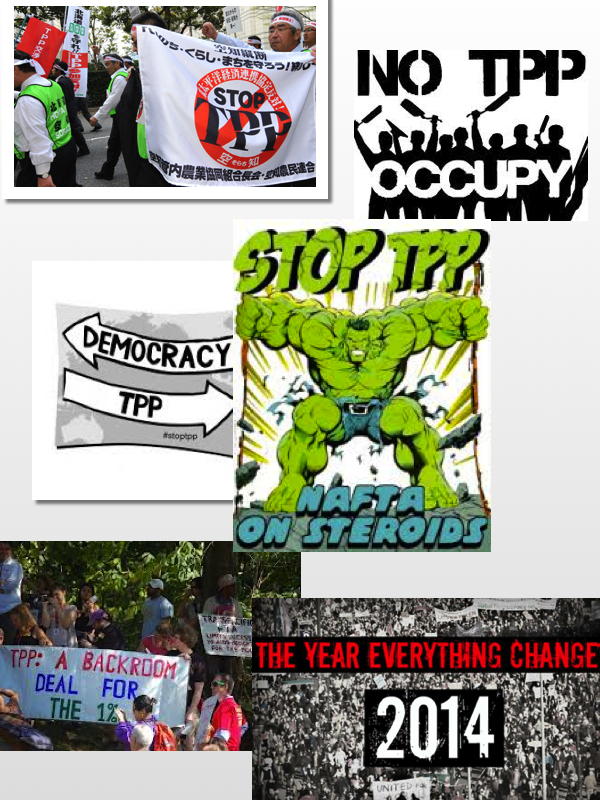
the interpretOr has posted recently on the Trans-Pacific Partnership (TPP), a massive trade agreement that’s being negotiated in secret by 12 countries across the Pacific. It has 29 chapters covering all kinds of regulations, and we only know what’s in it because of outdated leaks and government statements – (Bill Moyers: The Corporate Plot That Obama and Corporate Lobbyists Don’t Want You to Know About (AlterNet)
A huge number of groups and individuals are opposed to the TPP and other agreements like it for all kinds of different reasons. That’s because only a small part of these agreements deal with traditional “trade” issues like tariffs and market access. They cover regulations on everything from food labeling, labor standards, access to medicines, copyright enforcement, and cross-border investments. The problem is that the only interests that are represented at the negotiating table are corporate advisors—no public interest groups, no elected representatives, and no members of the public. That means that the rules that are in TPP are designed to give new rights and privileges to major corporations, while users, consumers, and everyone else get the worst end of the deal.
Now the White House and the US Trade Representative want the power to “fast track” TPP through Congress. The US Constitution gives Congress members the sole authority to regulate trade. But a new bill that was introduced would let Congress hand their powers over to Obama and the trade office, making this whole process even less transparent and less democratic. It’s called the “Bipartisan Congressional Trade Priorities Act” (HR.3830/S.1900) or TPA 2014 for short. If passed, it would severely curb Congress’ ability to conduct hearings and limit their power to solely an up or down, Yes or No vote. Stopping this fast track bill is a major part of the fight to block the passage of TPP and other secretive trade agreements.
Today, 10 days of action commence to stop this bill from passing. We’re here to share what we know about TPP, and answer your questions about why such a broad range of groups are opposed to this fast track bill. We need you to help us stop these toxic trade agreements, because mass public pressure is the most effective way to make the US government accountable.
Take Action:
- Stop Fast Track for the TPP!
- Electronic Frontier Foundation: Don’t Let Congress Fast Track TPP
- Open Media: Internet Censorship Petition
Outside the US? Learn more about the impact of trade policy from these organizations:
- En Español (Spanish): TPP Abierto
- 日本語 (Japanese): Stop TPP!!
- Canada (English): The Council of Canadians: Trans-Pacific Partnership
Learn more and take action here: Stop Fast Track
As a sweltering Australia struggles to contain nationwide bushfires, two new reports from reputable US organizations published in Bloomberg news.com, signal further alarming developments for the country to cope with.
Bloomberg reports that “Dangerous rises in the sea level or heat waves that kill crops can arrive quickly and leave little time to put preventative measures in place, according to a study from the National Research Council, a group of scientists providing information for U.S. government decision-makers.”
“The report — one of two issued today on climate change — calls for an early warning system to monitor climate conditions and improved models for predicting changes that impact the way people live. The alerts could be modeled on such programs as the National Integrated Drought Information System created by Congress in 2006 or the U.S. Agency for International Development’s Famine Early Warning System Network.
“In a separate report today, James Hansen, who warned of the dangers of global warming as early as 1988, said a United Nations-endorsed target of capping global warming is too high and will ensure future generations suffer “irreparable harm.”
Even limiting warming to 2 degrees Celsius (3.6 degrees Fahrenheit) above pre-industrial times would submerge coastlines, cause the mass extinction of species and trigger extreme weather, according to Hansen, former director of the NASA Goddard Institute for Space Studies and co-author of the report published today in the journal PLOS One.
“Two degrees Celsius warming above pre-industrial, which would mean about 1 degree Celsius warming above the present, creates a significantly different planet with enormous consequences, including eventually the un-inhabitability of coastal cities,” Hansen, adjunct professor at New York’s Columbia University’s Earth Institute, said at a briefing. “There’s no recognition of this in government policies.”
Australians have to sit out another 3 years of a government hell bent on ignoring these massive impacts on our climate our ecosystems and our coastal cities. Prime Minister Abbott studiously ignores the current climate extremes that are causing death and destruction in every state. To do so for much longer will ensure the death of his political party in the medium term.
Humanity at the Crossroads by Jim S…
In the furore surrounding the Edward Snowden and Wiki leaks revelations it is easy not to notice the connection to three other huge issues that are bearing down on humanity like the Four Horsemen of the Apocalypse.
These issues threaten every system that currently supports human existence and happiness on this planet.
The first system is democratic governance, the system of government where power is placed in the citizens to elect their peers to sit in a house of representatives to make rules that are in the best interest of the people that is government of the people by the people.
This is no longer the case in most Western democracies. Many Governments represent sectional interests who in turn fund their election and campaigns. These sectional interests undermine and take over the role and functions of government. Furthermore government departments have modelled themselves on corporations because they use corporate advisors to shape the management and ethos of government departments.
The second issue is the market economy that was designed as utilitarian system to benefit the whole of society by making finance available to build businesses and to provide fairly paid jobs. However, it has been undermined and has lost all sense of equity and balance. Furthermore the lack of sensible regulation has changed its main purpose to speculation with little regard for the production and sale of goods.
Having more and more wealth in fewer and fewer hands is bad for the economy overall and although the economic rise of Asia has seen many more people move from poverty to a middle class lifestyle, the trend in older market economies to less equality of wealth is accelerating.
The third problem area is the growing imbalance between the wealth and power between nation states and giant corporations. Corporations like the giant banks are seen as so integral to the economic basis of national economies they cannot be allowed to fail. These corporations however have no such loyalty to the governments that prop them up with taxpayer’s money and bank guarantees. They quite happily campaign against the same governments and against the interest of the people.
The most significant corporate sector in this power imbalance is the corporate media which the Leveson inquiry in the United Kingdom found that
…the evidence clearly demonstrates that, over the last 30-35 years and probably much longer, the political parties of UK national Government and of UK official. Opposition, have had or developed too close a relationship with the press in a way which has not been in the public interest.
The inquiry heard leading political witnesses say they feared the Murdoch press and courted its favour and that they were heavily criticised and crushed by his papers if Rupert Murdoch felt he could get a better deal from another party or politician.
Finally the most important issue, that of the rapid destruction of the earth’s biosphere and ecosystems has reached the point of mass extinction of species of plants and animals with no strong action or even agreement for action by national governments. Again this is because of dishonest campaigns by giant corporations using anti-environmental front groups to create division and confusion in the public mind about the reality and cost of climate change and its amelioration.
So what has this to do with the revelations of Edward Snowden?
Edward Snowden worked for a private corporation that spied on the online interactions of almost everyone on the planet. He was a just one part of a massive intrusive operation carried out supposedly for the USA Government to keep all Americans safe from terrorism “in the war against terrorism”.
In fact much of this information was being used against law abiding citizens and for the benefit of US corporations. An example of this was the spying on the Occupy movement who were peacefully protesting against the powerful corporations whose grubby share dealing bought about the world financial crisis and who wilfully mislead investors to induce them to buy worthless stock.
That the Occupy movement was spied on by the government may be excusable but their passing on of the information to the bankers and traders was not. This is and was an elected Government acting against the 99% of the people on behalf of the wealthy corporate 1%.
Of the incidents so far revealed, the most shocking instance of a government spying on the CMD (Campaign for Media and Democracy) an organisation that is fighting against the corporate takeover of government in the USA. This takeover has been done through ALEC ( the American Legislative Exchange Committee). ALEC consists of a group of large companies most of which are desperate to replace laws and regulations that might reduce their profits such as environmental protection, anti-smoking and health, workplace safety and gun laws.
ALEC also recruits and funds state and federal politicians to help them promulgate model laws which they then lobby heavily to push through state and federal legislatures.
After a recent rally protesting outside an ARLEC conference the CMD discovered that state based federal anti-terrorist agencies spied on the protest movement and passed on this information to ALEC. To make matters worse it was found that the uniformed police who had violently assaulted protest leaders had been off duty and were being paid by ALEC.
What this clearly signifies is that the US Government and many US State Governments are sharing security information and working with large corporations against peaceful community organisations and colluding in passing legislation that is against the interest of the American people.
How far this has spread into other Western democracies is not yet clear but there is evidence that police in the United Kingdom were being paid by the Murdoch press and this is possibly true of Australia where it has been reported that the Murdoch press reporter was tipped off about an impending anti- terrorist raid by a security officer.
What is most important about Snowden, Assange, Manning and the CMD, is not that they made public the invasive level of security in the USA and elsewhere, but that Governments are using the information against ordinary law abiding citizens and that the security apparatus is not only being operated by private companies but it is sharing that information with large corporations often against the public interest.
Citizens, the corporate state has arrived. It is in our bedrooms and on our private communication systems and you and democracy are its enemy.
In These Times, an independent, nonprofit magazine, is dedicated to advancing democracy and economic justice, informing movements for a more humane world, and providing an accessible forum for debate about the policies that shape our future.
Forever Temp?
Once a bastion of good jobs, manufacturing has gone gaga for temps.
By Sarah Jaffe
A Brief History of Anarchism
The struggle for the common good has a long past.
By Noam Chomsky
‘Sorry’ Not Good Enough for Chicago Torture Survivors
Rahm Emanuel needs to put his money where his mouth is.
By G. Flint Taylor and Joey L. Mogul
The Roots of the Tea Party
How conservatives came to dominate U.S. politics.
By Melvyn Dubofsky
Republicans (Still) Have a ‘Female Problem’
In the 2014 midterms, women will be the battleground. And one party has a leg up.
By Ruth Rosen
COMMENTARY
Weed Is Legal And Nobody Died
Washington’s fears of reefer madness haven’t come to pass in Colorado.
By David Sirota
WORKING IN THESE TIMES
Employees at Koch-Owned Georgia-Pacific Can Now Tweet About Work Without Fear
A new decree by the NLRB will allow employees of a Koch brothers owned company to post freely about their jobs to Facebook or Instagram without fear of retribution.
By Mike Elk
THE PRISON COMPLEX
Study funded by private prison dollars praises private prisons; no comment, says public university
A none-too-surprising finding.
By Matt Stroud
Want to stay up to speed with In These Times headlines every day? Follow us on Twitter and become a fan on Facebook.
Sponsors: In These Times is in part sponsored by the United Auto Workers of America (UAW), the American Federation of State, County & Municipal Employees (AFSCME), the Communications Workers of America (CWA) and the International Association of Machinists and Aerospace Workers (IAM).
Working In These Times is funded by The Public Welfare Foundation. We thank the foundation for its generous support. You can learn more about In These Times‘ sponsorship program here.
“My wife sometimes says, ‘I don’t think that person likes you.’ And I say, ‘How could they not like me? What are you talking about?’ And she says, ‘I think you’re missing the social signals.’
::: click here for piece in full @ the Monthly :::
…Christopher Whyne???
Current issue: January 2014
…France, political void at the top; EU,Bulgarians on the move; Iran, open for business; Iraq, Syria’s conflict spreads; Egypt, new script for young writers; acquiring nationality, special report ; Yugoslavia’s nationalist pop music; the road to Amazonia; video games, social control and big business; supplement, universal health cover… and more…
::: just click pic to access :::
Imagine what would happen if foreign companies could sue governments directly for cash compensation over earnings lost because of strict labour or environmental legislation. This may sound far-fetched, but it was a provision of the Multilateral Agreement on Investment (MAI), a projected treaty negotiated in secret between 1995 and 1997 by the then 29 member states of the OECD (Organisation for Economic Cooperation and Development) (1). News about it got out just in time, causing an unprecedented wave of protests and derailing negotiations.
Now the agenda is back. Since July the European Union and the United States have been negotiating the Transatlantic Trade and Investment Partnership (TTIP) or Transatlantic Free Trade Agreement (TAFTA), a modified version of the MAI under which existing legislation on both sides of the Atlantic will have to conform to the free trade norms established by and for large US and EU corporations, with failure to do so punishable by trade sanctions or the payment of millions of dollars in compensation to corporations.
Negotiations are expected to last another two years. The TTIP/TAFTA incorporates the most damaging elements of past agreements and expands on them…
::: click here for piece in full @ Le MondeDiplomatique :::
GENEVA (24 December 2013) – Two United Nations independent human rights experts today welcomed the publication of parts of Sir Peter Gibson’s interim report, an official investigation into the extent of the United Kingdom’s involvement in torture and other human rights violations concerning people detained overseas in the context of counter terrorism operations.
However, the UN Special Rapporteurs on torture, Juan E. Méndez, and the Special Rapporteur on the protection and promotion of human rights while countering terrorism, Ben Emmerson, expressed concern that a proposed official inquiry is to be entrusted to a parliamentary body, the Intelligence and Security Committee (ISC).
“The Gibson Inquiry suffered from a number of procedural shortcomings which were identified in my March report (see below) to the Human Rights Council,” Mr. Emmerson said, stressing that “the UK has, until now, indicated a commitment to the establishment of a judge-led inquiry to take forward the work of Sir Peter Gibson.”
“I am concerned that this proposal appears to have been abandoned in favour of a purely parliamentary inquiry which is likely to suffer from many of the same procedural shortcomings,” he warned. “I urge the British authorities to ensure that the fresh inquiry is given the powers it needs to get at the truth.”
Special Rapporteur Méndez also expressed disappointment that the inquiry would now be handed to the parliamentary Intelligence and Security Committee to examine and complete the investigations, as announced by the Minister without Portfolio Ken Clarke.
“It is particularly discouraging to know that the decision was handed over to the ISC which is known to have previously failed to fully investigate prior allegations of torture, ill-treatment, rendition and surveillance in the context of counter-terrorism and national-security,” the independent expert said, recalling the findings of the ISC 2007 report which concluded, among other things, that “no evidence [was found] that the UK Agencies were complicit in any ‘Extraordinary Rendition’ operations.”
Mr. Méndez reminded the UK Government of its obligation under the UN Convention against Torture*: “Each Government should undertake a prompt and impartial investigation wherever there are reasonable grounds to believe that torture has been committed, and prosecute suspected perpetrators of torture.”
“The British authorities should take persistent, determined and effective measures to have all allegations of torture or other cruel, inhuman or degrading treatment or punishment investigated promptly, effectively and impartially by an independent, competent domestic authority, as well as whenever there is reasonable ground to believe that such an act has been committed,” Mr. Méndez said quoting the Convention.
The expert stressed that UK Government also is obliged to hold responsible, bring to justice and punish all those who encourage, order, tolerate or perpetrate such acts responsible, including the officials in charge of the place of detention where the prohibited act is found to have been committed.
“The British Government should take note, in this respect, of the Principles on the Effective Investigation and Documentation of Torture and Other Cruel, Inhuman or Degrading Treatment or Punishment and the Updated Set of principles for the protection and promotion of human rights through action to combat impunity as a useful tool in efforts to prevent and combat torture,” he said.
Mr. Emmerson and Mr. Méndez will follow up with the UK Government over the terms of reference and powers of the Intelligence and Security Committee inquiry, with a view to determining whether it is capable of meeting international minimum standards.
(*) The Convention against Torture and Other Cruel, Inhuman or Degrading Treatment or Punishment: http://www.ohchr.org/EN/ProfessionalInterest/Pages/CAT.aspx
ENDS
Ben Emmerson (United Kingdom) is the Special Rapporteur on the promotion and protection of human rights and fundamental freedoms while countering terrorism. On 1 August 2011, he took up his functions on the mandate that was created in 2005 by the former United Nations Commission on Human Rights and renewed by the United Nations Human Rights Council for a three year period in September 2010. As Special Rapporteur he is independent from any Government and serves in his individual capacity. Learn more, log on to:http://www.ohchr.org/EN/Issues/Terrorism/Pages/SRTerrorismIndex.aspx
Check the Special Rapporteur’s report: http://www.ohchr.org/Documents/HRBodies/HRCouncil/RegularSession/Session22/A-HRC-22-52_en.pdf
Juan E. Méndez (Argentina) was appointed by the UN Human Rights Council as the Special Rapporteur on torture and other cruel, inhuman or degrading treatment or punishment on 1 November 2010. He is currently a Professor of Law at the American University – Washington College of Law and Co-Chair of the Human Rights Institute of the International Bar Association. Mr. Méndez has previously served as the President of the International Center for Transitional Justice (ICTJ) until 2009, and was the UN Secretary-General Special Advisor on the Prevention of Genocide from 2004 to 2007, as well as an advisor on crime prevention to the Prosecutor, International Criminal Court, between 2009 and 2010. Learn more, visit:http://www.ohchr.org/EN/Issues/Torture/SRTorture/Pages/SRTortureIndex.aspx
1. Want people to trust you? Try apologising for the rain.
“Superfluous apologies represent a powerful and easy-to-use tool for social influence,” the researchers said. “Even in the absence of culpability, individuals can increase trust and liking by saying ‘I’m sorry’ – even if they are merely ‘sorry’ about the rain.”
2. The 100+ most followed psychologists and neuroscientists on Twitter.
When we updated the list in July, the top five were: Andrew Mendonsa (clinical psychologist), Kiki Sanford (neurophysiologist turned science communicator), Sam Harris (neuroscientist and author), Richard Wiseman (psychologist, blogger and author) and Laura Kauffman (child psychologist). Look out for another update next year.
3. Smiling fighters are more likely to lose.
… [UFC] fighters who smiled more intensely prior to a fight were more likely to lose, to be knocked down in the clash, to be hit more times, and to be wrestled to the ground by their opponent (statistically speaking, the effect sizes here were small to medium). On the other hand, fighters with neutral facial expressions pre-match were more likely to excel and dominate in the fight the next day, including being more likely to win by knock-out or submission.
4. A study of suicide notes left by children and young teens.
Contrary to their predictions, the researchers said that “the notes are coherent and do not reveal confusion or overwhelming emotions. The children and young adolescents emphasise their consciousness of what they are about to do and they take full responsibility.”
5. Women’s true maths skills unlocked by pretending to be someone else.
By separating their performance from their own identity, it seems the women performing under an alias no longer felt pressure to avoid being seen as an example of the harmful gender stereotype [that women are weaker at maths than men].
6. Older, more experienced therapists cry more often in therapy.
Looking at the correlates of being a therapist who cries in therapy, it was older, more experienced therapists and those with a psychodynamic approach, who were more likely to be criers. Surprisingly perhaps, female therapists were no more likely to cry in therapy than male therapists, despite the fact that they reported crying more often in daily life than the men.
7. Kids experience schadenfreude by age four, maybe earlier.
The kids of all ages (four to age years) showed evidence of schadenfreude, suggesting their emotional response to another person’s distress was influenced by their moral judgements about that person. That is, they were more likely to say they were pleased and that it was funny if the story character experienced a misfortune while engaging in a bad deed.
| 8. LEGO figures are getting angrier. |
Nevermind increasingly violent video games or the ever-present danger of an uncensored internet, a far more insidious and unexpected change is afoot that could be affecting our children’s emotional development. Researchers have discovered that the faces on LEGO Minifigures are becoming increasingly angry and less happy.
9. The supposed benefits of open-plan offices do not outweigh the costs.
“Our results categorically contradict the industry-accepted wisdom that open-plan layout enhances communication between colleagues and improves occupants’ overall work environmental satisfaction,” the researchers concluded. They added: “… considering previous researchers’ finding that satisfaction with workspace environment is closely related to perceived productivity, job satisfaction and organisational outcomes, the open-plan proponents’ argument that open-plan improves morale and productivity appears to have no basis in the research literature.”
10. Working memory training does not live up to the hype.
The results were absolutely clear. Working memory training leads to short-term gains on working memory performance on tests that are the same as, or similar to, those used in the training. “However,” the researchers write, “there is no evidence that working memory training produces generalisable gains to the other skills that have been investigated (verbal ability, word decoding, arithmetic), even when assessments take place immediately after training.”
–Compare this year’s top 10 to last year’s.
–See also: the top 10 psychology books of 2013.
The number of teenagers deliberately hurting themselves is on the increase. For example, the latest data for England show that over 13,000 15- to 19-year-old girls and 4,000 boys were admitted to hospital for this reason in the 12-month period up to June this year, an increase of 10 per cent compared with the previous 12-month period. More than ever we need to understand why so many young people are resorting to this behaviour.
A common motivation teenagers give is that non-suicidal self-harm provides a way to escape unpleasant thoughts and emotions. Another motive, little explored before now, is that self-harm is a way to deliberately provoke a particular desired feeling or sensation. A new paper from US researchers has explored this aspect of self-harm, known as “automatic positive reinforcement” (APR).
Edward Selby and his colleagues gave 30 teenagers who self-harm (average age 17; 87 per cent were female) a digital device to carry around for two weeks. Twice a day, the device beeped and the teens were asked to record their recent thoughts of self-harm, any episodes of self-harm, their motives, their actual experiences of what it felt like, as well as answering other questions…
::: click here for piece in full @ BPS Research Digest :::
J citation: Edward A. Selby, Matthew K. Nock, and Amy Kranzler (2013). How Does Self-Injury Feel? Examining Automatic Positive Reinforcement in Adolescent Self-Injurers with Experience Sampling. Psychiatry Research DOI:10.1016/j.psychres.2013.12.005
Further reading…
Goth subculture linked with history of suicide and self harm
The attitude of casualty staff towards self-harm
Tattoos, body piercings and self-harm – is there a link?
The sight of their own blood is important to some people who self-harm
With China’s rapid industrialization and urbanization has come a growing interest in traditional Chinese culture on a spiritual level. As a means of restoring and repairing our own psychological lack, there has been a rush to make “the past” material and visible. How does this revivalism fit into contemporary art?
For this issue 艺术界 LEAP have invited experts in various fields including philosophy, art criticism, and architecture to debate the state of revivalism in Chinese contemporary art today. Lu Mingjun explains the 2,000-year-old ideological battle between present and past in Chinese thought, revealing a history of a continual synthesis of and opposition to foreign cultures. Pi Li examines the high points in traditional Chinese painting since the eighteenth century to reconsider and reinvigorate its study in the twenty-first-century, offering specific proposals for the theory, historical framework, and exhibition practice of ink painting. For his part, architect Wang Jiahao presents a very particular socio-historical viewpoint based on the history of architecture.
Meawhile, 艺术界 LEAP present the words and work of artists including Chen Zhiyuan, Hao Liang, Jin Shi, Taca Sui, Xie Fan, Zhang Xiaodi, Zhao Zhao, Shi Qing, and the Yangjiang Group, who treat the past as mentor, friend, family, and interlocutor, in order to question and resist what is inside their hearts, and what is outside. Concluding the middle section of this issue are two artist features. Contributor Freya Chou takes a look at the practice of Taiwanese artist Hsu Chia-Wei, which in its deconstruction and reconstruction of narrative space demonstrates a remarkably calm treatment of composition and objects. Meanwhile, critic Bao Dong analyzes how Liang Shuo deals with the cultural experiences in contemporary China that do not conform to artistic norms, transforming these into a method of inspiring aesthetic vigor…(艺术界 LEAP)
::: just click cover to access :::
“merry christmas, Herr Murdoch…” gushed the obsequious, fawning abbott, fumbling with his melting, sweaty toupee…”welcome back!”
“K, Abbott. K. Settle!” barked Roopert.
Look, quite frankly, we are so honoured to be graced by your presence this christmas, this white…white Australian christmas…
K. Just tweeted on way in from Kingsford Smith…
Oh, yes, master? An efficient and deeply masterful stroke of…stroke of the pen of modern technology…I just can’t…
S’enough of that, abbott. Settle! Tweet’s “Australia in deep economic trouble left by last six-year wildly incompetent govt. New govt must take quick, painful actions.”
Oh why thank you, Herr Murdoch…Another present? So soon? Why, than…
Caught American Hustle in the Lear on the way down…decadent nonsense ’bout most people ‘ll believe what they wanna believe.
Indeed, herr murdoch, indeed.
Not really, abbott, not at all really. Most people ‘ll believe what I wan’em ta believe…Uncle Roy Cohn taught me that one…
Indeed, herr murdoch, indeed.
(TBC)