“Australia needs to get our planes out of Syria. We’re only adding to the chaos and confusion, and putting more lives at risk. The Liberal Government couldn’t articulate a strategy or exit plan when this involvement first began, and this mess we’re in is the result.
“There is no clarity around this alliance. Nuclear-armed states with an already strained relationship are proceeding on an ad-hoc basis. Already we’ve seen the consequences of this, with Russian bombs seemingly striking US-backed rebels, not ISIS.
“This is a tinderbox set to explode. Airstrikes from all sides must cease until the anti-ISIS forces have a shared understanding of how they’ll proceed.
“Australia could play a key role in bringing those parties together, instead of participating in uncoordinated airstrikes in Syria.
“It was heartening to see the Labor party highlight the need for a debate about the attacks on Syria. Perhaps next time they’ll give our servicemen and women their due and join the Greens in making this point before our forces are deployed, instead of rubber stamping every Coalition misadventure overseas in an effort to avoid being labelled ‘weak’ on National Security.
Category: thus far…
excerpt…
DEC 17, 2015 SCIENCE
Can psychological research change your life? Most of the time, no—findings by psychologists don’t usually bear on everyday concerns. My colleagues at Yale, for instance, study topics such as the neuroscience of memory, how babies reason about social groups, and decision-making in psychopaths. Such studies are intended to explore how the mind works, and while their findings might ultimately make the world a better place—at least this is what we say in our grant proposals—that’s not their immediate focus…
::: click on through to the Atlantic for piece in full + open source :::
Paul Bloom is a contributing writer for The Atlantic and the Brooks and Suzanne Ragen Professor of Psychology at Yale University. He is the author of a forthcoming book about empathy.
The Powers of Ten films are two short American documentary films written and directed by Charles and Ray Eames. Both works depict the relative scale of the Universe according to an order of magnitude (or logarithmic scale) based on a factor of ten, first expanding out from the Earth until the entire universe is surveyed, then reducing inward until a single atom and its quarks are observed.
Marina Abramović’s art pushes the boundary between audience and artist in pursuit of heightened consciousness and personal change. In her groundbreaking 2010 work, “The Artist Is Present,” she simply sat in a chair facing her audience, for eight hours a day … with powerfully moving results. Her boldest work may still be yet to come — it’s taking the form of a sprawling art institute devoted to experimentation and simple acts done with mindful attention. “Nothing happens if you always do things the same way,” she says. “My method is to do things I’m afraid of, the things I don’t know, to go to territory that nobody’s ever been.
The Indigenous Peoples’ Pavilion at the UNFCCC COP 21 in Paris is located within the civil society ‘Climate Generations Space’, directly adjacent to the COP 21 “Blue Zone” negotiation space.
The Indigenous Peoples’ Pavilion is organized and programmed by the International Indigenous Peoples’ Forum on Climate Change (IIPFCC) with support from the Governments of Norway and France, in addition to UNDP.
Indigenous Peoples around the wOrld…
There are over 370 million indigenous people around the world. They have their own distinct languages, cultures, and social and political institutions apart from mainstream society. Though divided amongst all continents, at least 5000 different peoples, and approximately 4000 languages, they are coming together with a common voice to address historic inequities which have resulted in these groups being some of the most marginalized and victimized communities.
Indigenous Peoples, the Environment and Climate Change…
Given their widespread reliance on natural resources and ecosystems, indigenous peoples and local communities are especially vulnerable to, and disproportionately impacted by, climate change. They are being forcibly removed from their lands by deforestation, sea-level rise, major infrastructure projects, and conflict arising from resource scarcity. All the while, they play a critical role in climate change mitigation and adaptation through their historic and effective role as stewards of much of the world’s remaining forests….
source: IIPFCC ::: click logo, or here, to access :::
As climate talks in Paris approach, stakes are high for frontline communities with the most to lose. Yesterday, UNICEF reported that children will suffer the harshest impacts from rising temperatures. Their findings revealed that “over half a billion children live in extremely high flood occurrence zones; nearly 160 million live in high or extremely high drought severity zones.”
The billions of children in these vulnerable areas are also living below the poverty line. Along with death and devastation brought on by climate change impacts, rising temperatures can also contribute to malnutrition, malaria and diarrhea — all of which are deadly to children. With the WMO revealing that this year is the hottest on record, NGOs are turning up the pressure on negotiators to deliver an even stronger deal to “avert these costs for the world’s poorest people.”
Coverage
- Ethiopia: Unicef Says Children Will Bear the Brunt of Climate Change (AllAfrica)
- 690 Million Children At Risk From Impacts Of Climate Change: UNICEF (Tech Times)
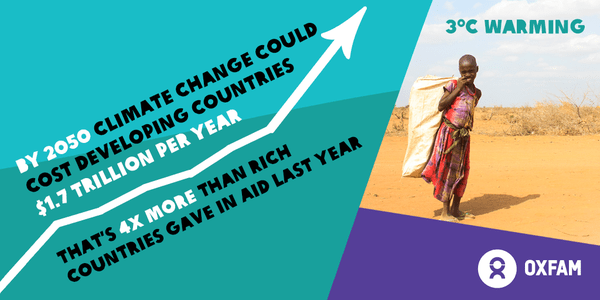
- Poor nations face soaring costs if warming limit exceeded – Oxfam (Reuters)
- Oxfam puts the spotlight on adaptation funds ahead of Paris talks (Deutsche Welle)
Tools and Resources
- Press Release: 2015 likely to be Warmest on Record, 2011-2015 Warmest Five Year Period (WMO)
- Press Release: Delays in cutting emissions set to cost developing countries hundreds of billions of dollars more (Oxfam)
- Report: Game-changers in the Paris climate deal (Oxfam)
- Coverage: Children will bear the brunt of climate change – UNICEF report (UN News Centre)
- Op-ed: Paris climate deal needs solidarity on loss and damage (Climate Home)
- Briefing: Community-based adaptation: managing uncertainty (Care International)
- Briefing: Natural catastrophes and climate change (Swiss Re)
- Report: Severe weather in North America (Munich Re)
- Briefing: Climate change and the financial services sector (Allianz)
- Report: Communicating flood risks in a changing climate (Climate Outreach)
There is perhaps no better demonstration of the folly of human conceits than this distant image of our tiny world. To me, it underscores our responsibility to deal more kindly with one another, and to preserve and cherish the pale blue dot, the only home we’ve ever known.
Carl Sagan
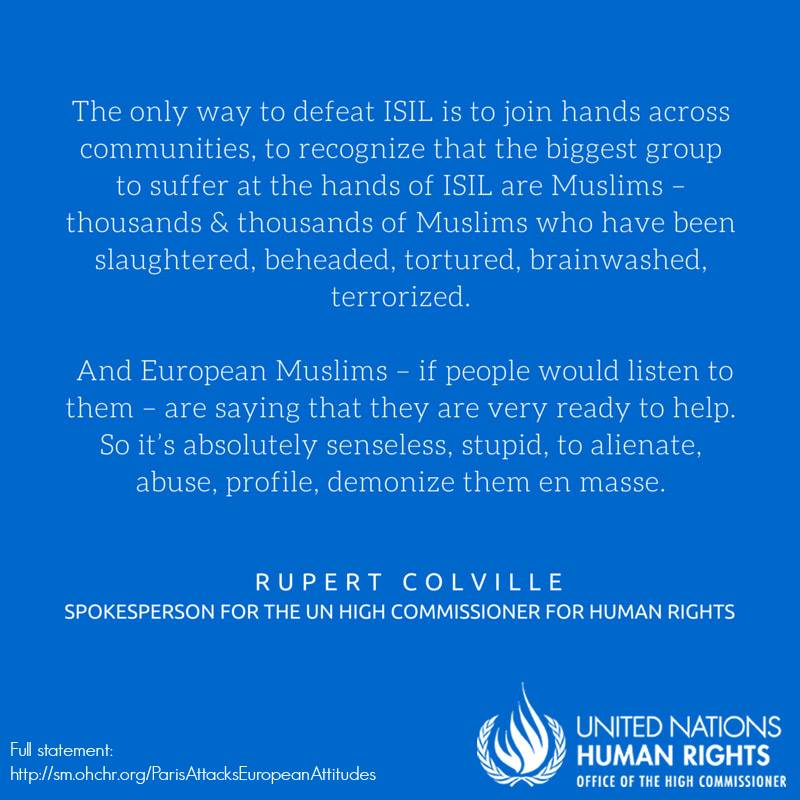
We must show Islamophobes that there is no clash of civilizations; just a clash of moral values between decent human beings and mass-murdering lunatics.
Excerpt…
It can be hard not to fall for simplistic narratives fed to us by mainstream media during such times. After all, it seems more convenient to believe that the Paris attacks demonstrate that there is a war between the West and Islam as it provides a relatively straightforward answer to a largely complex problem. However, such rhetoric, whether we realise or not, only strengthens the narrative of IS.
“Attacks like the ones tonight in Paris are committed to purposely trigger an Islamophobic backlash,” writes Nader Atassi, an anti-IS blogger. “That backlash is not an unintended consequence of such attacks; it is part of their logic. Isis wants an Islamophobic backlash because it lends credence to their narrative that there is a war between the West and Islam. By strengthening and emboldening the xenophobic right-wing in Europe, they strengthen their own worldview as well. And the most tragic irony is that the backlash may target refugees who themselves had been fleeing Isis’ reign of terror.”
::: just click New Statesman logo above for this and other pieces, free + in full :::
excerpt of piece by Laila Lalami @ The Nation…
What happened in Paris on November 13 has happened before, in a shopping district of Beirut on November 12, in the skies over Egypt on October 31, at a cultural center in Turkey on July 20, a beach resort in Tunisia on June 26—and nearly every day in Syria for the last four years.
The scenario is by now familiar to all of us. News of the killings will appear on television and radio. There will be cries of horror and sorrow, a few hashtags on Twitter, perhaps even a change of avatars on Facebook. Our leaders will make staunch promises to bring the terrorists to justice, while also claiming greater power of surveillance over their citizens. And then life will resume exactly as before.
Except for the victims’ families. For them, time will split into a Before and After. We owe these families, of every race, creed, and nationality, more than sorrow, more than anger. We owe them justice.
We must call to account ISIS, a nihilistic cult of death that sees the world in black and white, with no shades of gray in between.We must call to account Bashar al-Assad, whose response to peaceful protesters in the spring of 2011 was to send water cannons and military tanks to meet them.
We must call to account the governments of the United States, France, Britain, Russia, Iran, and many others, who lent support and succor to tyrant after tyrant in the Middle East and North Africa, and whose interventions appear to create 10 terrorists for every one they kill.
We must call to account George W. Bush and Dick Cheney, whose disastrous invasion of Iraq in 2003 and subsequent disbanding of the Iraqi army destabilized the entire region.
Wahhabi ideas have spread throughout the region not because they have any merit—but because they are well funded. We must call to account the Saudi kings—Salman, Abdullah, and Fahd—whose funding of Wahhabi doctrine gave rise to the scourge of Islamic extremism…’
::: click on through here for piece in full + free @ The Nation :::
…excerpt from The Tree:
In the first concrete legal action against ExxonMobil’s web of climate lies, New York Attorney General Eric Schneiderman has announced he will investigate whether the oil giant knowingly misled the public and investors about the dangers of climate change. Last month from InsideClimate News and the Los Angeles Times revealed that Exxon’s own scientists warned the company’s top leadership that burning fossil fuels causes climate change with potentially “catastrophic” impacts as far back as 1977. Yet despite this warning the company spent decades funneling millions of dollars into groups that dispute or cast doubt on the connection between fossil fuels and climate change. With the dirty tactics of fossil fuel companies well and truly in the open, the ExxonMobil investigation should be a warning shot for other companies that they will no longer be allowed to peddle misinformation and must once and for all wake up to the dampening demand for fossil fuels…
More recent coverage of Exxon Mobil climate change revelations…
- More oil companies could join Exxon Mobil as focus of climate investigations (New York Times)
- ExxonMobil under investigation over claims it lied about climate change risks (Guardian)
- Exxon Mobil investigated in New York over possible lies on climate (New York Times)
- Gore calls for Exxon Mobil inquiry on climate change (New York Times)
- Congressmen call on SEC to investigate Exxon’s climate disclosures (Inside Climate News)
- Exxon knew about climate change almost 40 years ago (Scientific American)
- ExxonMobil targets journalists and activists after climate change investigation (Motherboard)
Projected impact of the former on Paris Climate Talks?
The New Matilda:
‘Malcolm Turnbull’s Dirty Money Means Oz Won’t Be Taken Seriously At Paris Climate Talks, says 350.org’
Climate advocacy group 350.org has demanded Malcolm Turnbull divest from ExxonMobil, which is under investigation for a climate change cover-up…
::: click here for piece in full @ The New Matilda :::
PATRICK COCKBURN
Russia in Syria
The military balance of power in Syria and Iraq is changing. The Russian air strikes that have been taking place since the end of September are strengthening and raising the morale of the Syrian army, which earlier in the year looked fought out and was on the retreat. With the support of Russian airpower, the army is now on the offensive in and around Aleppo, Syria’s second largest city, and is seeking to regain lost territory in Idlib province. Syrian commanders on the ground are reportedly relaying the co-ordinates of between 400 and 800 targets to the Russian air force every day.
As Mental Health Week 2015 draws to a close, here’s an enaging and succinct short on Mindfulness…
After marathon negotiations in Atlanta, leaders from 12 nations cement pactwhich coalition of critics say will raise the price of essential drugs, drive industrial scale agribusiness, and threaten workers rights…
by Lauren McCauley, staff writer
Amid a last minute scramble, leaders from the United States and 11 other Pacific Rim countries announced Monday that they had reached agreement on a sweeping trade deal, one that critics, including US presidential candidate Bernie Sanders, say will slash standards and protections for both consumers and workers—with impacts to be felt across the globe.
The agreement, known as the Trans Pacific Partnership (or TPP), which would tie together as much as 40 percent of the world’s economy, has for nearly 8 years been negotiated in secret. Though details of the compromise were not yet revealed early Monday, critics said that—minutia aside—the global trade pact will certainly be a boon for corporate power…
“TPP is a deal for big business,” said Nick Dearden, director of the UK-based Nick Dearden,Global Justice Now.
“Wall Street and other big corporations have won again. It is time for the rest of us to stop letting multi-national corporations rig the system to pad their profits at our expense.”
– Bernie Sanders
Presidential candidate Bernie Sanders was also quick to condemn the deal. Saying he was disappointed but not surprised by the “disastrous” agreement, Sanders added: “Wall Street and other big corporations have won again. It is time for the rest of us to stop letting multi-national corporations rig the system to pad their profits at our expense.”
The compromise was reached after five days of round-the-clock negotiations in Atlanta, Georgia. U.S. President Barack Obama reportedly “spent recent days contacting world leaders to seal the deal.”
The negotiations had been extended after talks got stuck over the issue of how long a monopoly period should be allowed on next-generation biotech drugs. The compromise reportedly reached between the U.S. and Australia “is a hybrid that protects companies’ data for five years to eight years,” the New York Times reports, falling short of the 12 years desired by U.S. negotiators…’
::: click on through for this piece in full @ CommonDreams.org :::
Two years after NSA whistleblower Edward Snowden‘s revelations made global headlines, a new international pact for privacy rights is being launched—the Snowden Treaty, an agreement that would “curtail mass surveillance and protect the rights of whistleblowers.”
“Protecting the right to privacy is vital not just in itself but because it is essential requirement for exercise of freedom of opinion and expression, the most fundamental pillars of democracy,” the drafters—Snowden, journalists Laura Poitras and Glenn Greenwald, and Greenwald’s partner David Miranda—explain in their proposal, which will be formally introduced at a press conference on Thursday and encourages both individual citizens and global governments to sign up.
The proposal states:
- We demand for privacy on the internet.
- We demand that the government grant us the right to privacy in our homes.
- We demand that the government protect our personal privacy online.
Launched along with the website SnowdenTreaty.org, the pact is officially titled theInternational Treaty on the Right to Privacy, Protection Against Improper Surveillance and Protection of Whistleblowers (pdf).
“Signatories to the treaty will be obliged to enact concrete changes to outlaw mass surveillance. The Treaty would also develop international protections for whistleblowers,” the pact states.
Story in full @ Common Dreams
News & Views | 09.18.15
Featured…
![]() |
Refugees Left Stranded As EU Faces ‘Crisis of Political Will’ by Andrea Germanos “You aren’t going to solve these problems by closing borders.” |
|
News…
![]() |
‘Foolish and Mean-Spirited’: US House Votes to Defund Planned Parenthood by Deirdre Fulton Both measures are opposed by women’s health organizations, the White House, and a majority of the American public. |
|
![]() |
Citing Abuses, US Commission Demands Release of Refugee Families by Sarah Lazare The violations are so egregious that all families should be released, detentions reduced, and alternatives to incarceration fostered. |
|
![]() |
Up 72 Perecent From Just Six Years Ago, Organic Farm Sales Soar by Nadia Prupis Americans are increasingly hungry for naturally-grown and healthier foods. |
|
![]() |
Facing South, Bernie Sanders Ramps Up Outreach in SC and Beyond by Deirdre Fulton David is rising against Goliath, with a grassroots campaign meant to increase Sanders’ exposure among minority voters in the Bible Belt and across the South. |
|
![]() |
According to New IEA Chief, Arctic Drilling Is Stupid Business by Sarah Lazare Birol’s statements come amid growing calls to place people and the planet over profit by leaving fossil fuels in the ground. |
|
![]() |
New Orleans Running ‘Modern Debtors Prison,’ Lawsuit Charges by Nadia Prupis Orleans Parish has resurrected unconstitutional “debtors’ prisons” by routinely jailing the region’s poorest residents over their inability to pay court fees and other fines. |
|
| more news… |
Views…
![]() |
Obama’s Fateful Syrian Choice by Robert Parry He can either work with Russia’s President Putin to stabilize Syria or he can opt for a confrontation that could lead to an open-ended war. |
|
![]() |
The Fed Gets It Right. Now Let’s Move to Full Employment by Isaiah Poole “The case for raising short-term interest rates is extraordinarily weak. That is not the economy we have today.” |
|
![]() |
Open Homes, Open Borders: A Dispatch from a German Village Sheltering 400 Refugees by Melody Ermachild Chavis There is no end to the long line of human beings underway tonight. |
|
![]() |
Standing With Ahmed and All Children of Color by Sonali Kolhatkar If Obama truly wants America to be great, as his tweet to Ahmed suggests, he can begin by making it a country that treats its Muslim citizens without suspicion. |
|
![]() |
Resisting the Lure of Intervention by John Feffer With each nuclear weapon, jet engine, and space rocket we deploy, we venture further into the Orange Zone, heading blindly, if not boldly, toward the point of no return. |
|
![]() |
The Republican Foreign Policy Consensus: Lunacy by Robert Borosage If you want a president to lead us into constant wars “anywhere in the world,” Republicans have your man. |
|
| more views… |
Under the Trans-Pacific Partnership (TPP), multinational corporations will be able to sue the Australian Government in secret corporate courts over laws that protect our health, environment and workers’ rights.
Australians voted for the government to run our country in the interests of the public, not corporations. Don’t let them hand sovereignty of our country over to foreign corporations.
Learn more about the TPP here: www.getup.org.au/tpp
UNHCR’s Global Trends report shows that in 2014 alone 13.9 million became newly displaced – four times the number in 2010. Worldwide there were 19.5 million refugees (up from 16.7 million in 2013), 38.2 million were displaced inside their own countries (up from 33.3 million in 2013), and 1.8 million people were awaiting the outcome of claims for asylum (against 1.2 million in 2013). Alarmingly, over half the world’s refugees are children.
“With huge shortages of funding and wide gaps in the global regime for protecting victims of war, people in need of compassion, aid and refuge are being abandoned,” said Guterres. “For an age of unprecedented mass displacement, we need an unprecedented humanitarian response and a renewed global commitment to tolerance and protection for people fleeing conflict and persecution.”
Syria is the world’s biggest producer of both internally displaced people (7.6 million) and refugees (3.88 million at the end of 2014). Afghanistan (2.59 million) and Somalia (1.1 million) are the next biggest refugee source countries.
Even amid such sharp growth in numbers, the global distribution of refugees remains heavily skewed away from wealthier nations and towards the less wealthy. Almost nine out of every 10 refugees (86 per cent) were in regions and countries considered economically less developed. A full quarter of all refugees were in countries ranking among the UN’s list of Least Developed nations…
The full Global Trends report with this information and more, and including data on individual countries, demographics, numbers of people returning to their countries, and available estimates of stateless population is available at http://www.unhcr.org/2014trends.
Senator Scott Ludlam…
With opposition to the Perth Freight Link mounting, a Senate inquiry underway and the government’s credibility crumbling, it’s time to encourage the three main companies bidding to build this toxic freeway to walk away.
The Perth Freight Link is a $1.6 billion project to construct 14km of freight freeway through our communities and bushland, including the Beeliar Wetlands.
More than 30 separate community groups are fighting to stop this incredibly expensive and unnecessary road from being built.
With mounting opposition and doubt hanging over the project it’s guaranteed that any company involved in the Perth Freight Link will face costly delays and tarnished reputations.
We’ve also produced a series of postcards to send to the tender companies. To request some postcards phone 08 9335 7477 or email aimee.smith@aph.gov.au with your postal address and the number of cards you can use.
A toxic freeway that would cause permanent and irreparable harm…
With Australia enduring the mysery of Murdoch-Minion rule, and Fox News launching Bush III out of the US, we believe that now is the time to counter the mendacious mantras of perpetual war, sacred markets and Iraq revisionism with an evidence-based reality check.
To get the ball rolling, here’s a heads up from former CIA analyst, Paul R. Pillar, via Consortiumnews.com…
“Having escaped accountability for the Iraq War disaster, U.S. neocons are urging the use of more military force in the Mideast, in line with Israeli Prime Minister Netanyahu’s demand to block the Iran nuclear deal. From their important perches of power, these war hawks also twist the history of their catastrophic misjudgments…” writes ex-CIA analyst Paul R. Pillar.
“Now the Republican presidential candidate who is the front-runner for the nomination among those whose name is not Trump has joined in the promoting of the Iraq War myth.”
Paul R. Pillar, in his 28 years at the Central Intelligence Agency, rose to be one of the agency’s top analysts. He is now a visiting professor at Georgetown University for security studies.
…banner above clicks through to podcast…
RECENT ISSUES
- Frederick Wilmot-Smith: Court Cuts
- Sheila Fitzpatrick: What Stalin Built
- Julian Barnes: Selfie with ‘Sunflowers’
- Rosemary Hill: Edward and Mrs Simpson
The author and pioneering University of Texas psychologist explains how awareness of your own thoughts and feelings can lead you to be kinder toward yourself—and why this self-compassion brings a host of mental and physical health benefits.
More about Kristin Neff.
via GreaterGood
A former CIA officer described as the latest victim of the Obama administration’s war on whistleblowers has issued a scathing open letter to civil rights groups asking, “Where were you?”…
In the letter published at the St. Louis Post-Dispatch, Jeffrey Sterling, who is black, specifically calls out the NAACP, National Action Network, Rainbow PUSH Coalition, and Congressional Black Caucus, writing “I saw you when other black faces were either killed or mistreated.” But, to these civil rights groups, he writes, he is “invisible.”
In a case that relied on circumstantial evidence, Sterling was convicted in January on nine separate felony charges, including seven counts of espionage.
He was given a 42-month sentence in May, which Norman Solomon, executive director of the Institute for Public Accuracy and coordinator of whistleblower advocacy organization ExposeFacts.org, described as “the continuation of a war on whistleblowing and journalism, to clamp down on the absolutely essential flow of information for democracy.”
::: click here or banner for piece in full @ CommonDreams :::
blurb…
Contemporary art always encompasses various disciplines. As art becomes a central part of mainstream culture in China and elsewhere, our plea is that it can contribute in a subcultural sense—not necessarily as the politically vigilant gadfly it was once imagined to be, but as a challenger of a new type. LEAP 33’s cover package “the Ends of Culture” stems from our observations on subculture. The premise is simple: rather than approaching art through cultural and conceptual matrices, we read it through its objects, artifacts, and images. In this cover package, we provide a cluster of keywords that act as a conduit towards the edge of the cultural imagination; like the catalysts and enzymes that encourage a system to grow from within, we hope to create the conditions for the creation, misinterpretation, disruption, and total collapse of an entire cognitive structure.
In addition to the cover feature’s 43 entries of subcultural keywords, this issue’s middle section includes the inaugural edition of LEAP Forum. LEAP Forum / Venice 2015: New Pavilions for a Global Asia brings together artists, curators, and other participants in projects across Venice—from the international exhibition to the national pavilions and collateral shows—to discuss and explore the rapidly changing state of Asian visual culture in the world today. Also featured are two in-depth artist profiles. Colin Siyuan Chinnery analyzes the ways artist Wang Yin incorporates Chinese avant-garde theater and modern culture into his paintings, drawing up a narrative of contemporary China’s cultural ideology and national memories. Matthew Shen Goodman offers an incisive account of recent Hugo Boss Prize winner Paul Chan’s practice, and his tongue-in-cheek attitude towards the art world.
|
TOP STORIES THIS WEEK
|
|
A California judge affirmed that it’s illegal to detain children, and ordered their mothers released, too.
BY JOSEPH SORRENTINO Attendees at parties across Iowa say that Bernie is “the guy we need right now.” BY DAVID GOODNER Andrew Highsmith charts the rise and fall of Flint, a city deserted by industry and divided by segregation. BY DANIEL HERTZ The cure for planned Apple-escence. BY KENDRA PIERRE-LOUIS The vision of the socialist organizer remains inspiring.
BY MAURICE ISSERMAN U.S. media commentary on the accord portrays U.S. global military supremacy as natural and desirable.
BY GREGORY SHUPAK Critics who simply claim that “Coates is no Baldwin” are ignoring what can be a comparison that allows us to understand both writers more deeply. BY ANDY SEAL On postwar anti-communist surveillance in Britain.
BY JANE MILLER Continually policing the ways women talk will further reduce them to silence. BY MAX BLUMENTHAL |
| WORKING IN THESE TIMES |
| As Nabisco Ships 600 Jobs Out of Chicago to Mexico, Maybe It’s Time To Give Up Oreos
Chicago is poised to lose 600 well-paying jobs on the city’s Southwest Side. BY MARILYN KATZ |
| RURAL AMERICA |
|
In his new climate encyclical, Pope Francis seeks to rekindle ecological consciousness. BY DAYTON MARTINDALE
|
The coal industry’s misleading attempts to brand itself as a poverty fighter continue to unravel, with a new report from Oxfam demonstrating that renewable energy is the easiest, cheapest, and most effective method to give people life-changing energy access. The Powering Up Against Poverty report shows that given its heavy health and climate impacts, coal is an ill-conceived solution to bring power to one billion people around the world and, as 84 per cent of the energy poor live in rural areas, the cost of extending electricity grids to those rural areas is prohibitively expensive. Oxfam has also warned the Australian Government – which has been aggressively parroting coal industry rhetoric – that it is time to end its love affair with coal, as it’s risking not only the global climate, but its economic and political future, given the growing emphasis on renewable energy in China, India, Africa and major economies like the US.
Renewables are the best and only choice to address energy poverty in the developing world. Oxfam notes that four out of five people without electricity live in rural areas that are often not connected to a centralised energy grid. Renewable energy solutions offer them a much more affordable, practical and healthy solution than coal. Coal’s so-called ability to lift them out of poverty is a PR exercise, as the health, climate, and economic consequences that come with coal do far more harm than good. Fossil fuels cost society US$105-$122 per tonne of carbon dioxide – two to nine times their total revenue – according to a University of Cambridge study. Companies like Peabody Energy have a net negative economic contribution to society and, as this becomes clearer, it is little wonder why the transition to clean, renewable energy is picking up steam faster than many imagined.
Climate change is hitting poor communities first and hardest, and coal is the biggest single contribution to climate change.Addressing climate change and reducing poverty go hand in hand. From an energy access point of view, renewables offer the cheapest, fastest, and healthiest way to increase energy access, which is why the world is shifting from fossil fuels to renewable energy faster than most had predicted. With its heavy environmental, health and economic impacts, coal is a major threat in the fight against hunger and poverty.
Coal is not “good for humanity”, and it’s not even good for coal companies. The changing energy landscape globally has seen coal giant Peabody Energy’s stock price sink like a stone. The company has lost just over a billion US dollars in three months, making it one of the world’s most high-profile examples of the ongoing death of fossil fuels. It may think that it can save its skin by rebranding itself as a poverty fighter but, as Oxfam notes: coal companies make heavy indirect contributions to climate change and the floods, drought, cyclones and changes to food patterns it brings. They also contribute directly through air pollution problems and displacement of communities as coal mines force them off their land, leaving them with poor access to food and water and struggling to make a living. Simply put, coal companies have no moral argument for poverty alleviation.
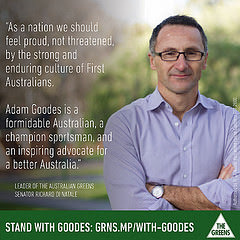
Adam Goodes is a proud Adnyamathanha man. He celebrates his Indigenous culture and calls out racism when he sees it.
We stand with him.
|
|
|
To mark the 800th year of Magna Carta, the Australian Human Rights Commission has released an animation, interactive infographic and teachers resource on the story of our freedom.
Transcript is at https://www.humanrights.gov.au/magnacarta/video/transcript.html
Animation produced by The Explainers.
|
|