Category: thus far…


Chief UN investigator of North Korean human rights abuses, Michael Kirby, discusses the allegations of crimes against humanity:
North Korea is truly a totalitarian state … It is not content to take control of the physical lives of the citizens, it has to intrude into their way of thinking, into their attitudes to government … [It implements] the system of characterising citizens according to their loyalty to the government and the party. This is truly a state without any real equivalent in the modern world.
Michael Kirby
The UN-mandated inquiry team says the country’s leadership should be hauled before at the International Criminal Court:
…the inquiry found that pregnant women are starved, while their babies are fed rats and snakes; more than 100,000 people are in gulags; there is systematic torture; everyone is forced to inform on each other; entire communities are denied adequate food; and the bodies of the dead…
View original post 34 more words

POPULAR
 SONY HACK: CLOONEY SAYS MOVIE IS ABOUT SNOWDEN, NOT JOURNALISM
 IRONY 101: STUDY ETHICS WITH LEGAL ACE WHO SANCTIONED NSA WIRETAPPING, CIA TORTURE
 MEET ALFREDA BIKOWSKY, THE SENIOR OFFICER AT THE CENTER OF THE CIA’S TORTURE SCANDALS
 BILLION DOLLAR SURVEILLANCE BLIMP TO LAUNCH OVER MARYLAND
 THE LATEST TWIST IN THE BIZARRE PROSECUTION OF BARRETT BROWN



As Australia picked up its shameful fourth Fossil of the Day award at the Lima climate talks Thursday (11/12/14), Climate Action Tracker (CAT) released a new analysis showing that creative accounting and years of diplomatic manoeuvring are allowing Australia to increase emissions while still meeting its minimum five per cent reduction commitment. CAT says in real terms Australia’s emissions are likely to be 26 per cent above 2000 levels by 2020, and a huge 47-59 per cent above its original Kyoto pledge.
Yet while its actual emissions are soaring, Australia can still meet its already lax commitments with barely any action thanks to being selective on baseline emission sources, and its creative approach to accounting for land use change and forestry. Australia has now taken to making threats if it is not allowed to use these favourable rules, which would allow it to emit a further six per cent more carbon on top of its already worst-in-show per capita emissions.

extract…
International law prohibits the granting of immunities to public officials who have engaged in acts of torture. This applies not only to the actual perpetrators but also to those senior officials within the US Government who devised, planned and authorised these crimes.
As a matter of international law, the US is legally obliged to bring those responsible to justice. The UN Convention Against Torture and the UN Convention on Enforced Disappearances require States to prosecute acts of torture and enforced disappearance where there is sufficient evidence to provide a reasonable prospect of conviction. States are not free to maintain or permit impunity for these grave crimes.
It is no defence for a public official to claim that they were acting on superior orders. CIA officers who physically committed acts of torture therefore bear individual criminal responsibility for their conduct, and cannot hide behind the authorisation they were given by their superiors.
However, the heaviest penalties should be reserved for those most seriously implicated in the planning and purported authorisation of these crimes. Former Bush Administration officials who have admitted their involvement in the programme should also face criminal prosecution for their acts.
President Obama made it clear more than five years ago that the US Government recognises the use of waterboarding as torture. There is therefore no excuse for shielding the perpetrators from justice any longer. The US Attorney General is under a legal duty to bring criminal charges against those responsible.
Torture is a crime of universal jurisdiction. The perpetrators may be prosecuted by any other country they may travel to. However, the primary responsibility for bringing them to justice rests with the US Department of Justice and the Attorney General.”
(*) Check the Special Rapporteur’s full report: http://www.ohchr.org/Documents/HRBodies/HRCouncil/RegularSession/Session22/A-HRC-22-52_en.pdf
Ben Emmerson (United Kingdom) is the Special Rapporteur on the promotion and protection of human rights and fundamental freedoms while countering terrorism. On 1 August 2011, he took up his functions on the mandate that was created in 2005 by the former United Nations Commission on Human, renewed by the UN Human Rights Council for a three year period in December 2007, in September 2010 and again in March 2013. As Special Rapporteur he is independent from any Government and serves in his individual capacity. Learn more, log on to:http://www.ohchr.org/EN/Issues/Terrorism/Pages/SRTerrorismIndex.aspx
The Special Rapporteurs are part of what is known as the Special Procedures of the Human Rights Council. Special Procedures, the largest body of independent experts in the UN Human Rights system, is the general name of the Council’s independent fact-finding and monitoring mechanisms that address either specific country situations or thematic issues in all parts of the world. Special Procedures’ experts work on a voluntary basis; they are not UN staff and do not receive a salary for their work. They are independent from any government or organization and serve in their individual capacity.
UN Human Rights, country page – United States of America: http://www.ohchr.org/EN/Countries/ENACARegion/Pages/USIndex.aspx
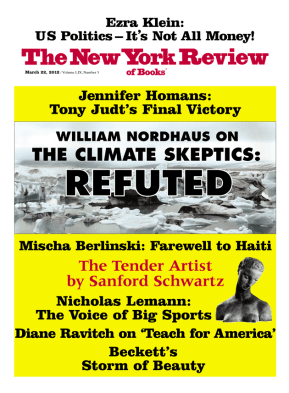
“Why the Global Warming Skeptics Are Wrong”
William D. Nordhaus is Sterling Professor of Economics at Yale. (March 2012)
His evidence based article is freely available below and above at
the New York Review of Books…
www.nybooks.com/articles/archives/2012/mar/22/why-global-warming-skeptics-are-wrong/


Rupert Murdoch ordered editors to ‘kill Whitlam’, according to US diplomatic cables
http://t.co/9SA0wmTT06 #auspol
Rupert Murdoch ordered editors to ‘kill Whitlam’, according to US diplomatic cables #auspol

Document date: 2014-10-20 23:54:11
Released date: 2014-10-20 23:54:11

‘A treasurer under siege, a foreign minister in a sulk and a defence minister about to be forced to walk the plank.






:::: click above for our SATIRE section :::

The UN Climate Talks, otherwise referred to as COP 20, begin next week in Lima, Peru at a time when climate change has rocketed back to the top of the global political agenda. The Lima talks are an opportunity for governments to harness momentum that has been growing around the world for months and begin taking internationally coordinated action to address the global climate change crisis. In Lima, governments can move forward on an international action plan to be finalized in Paris at the end of next year, which aims to accelerate the ongoing transition away from dirty fossil fuels to 100% renewable energy.
The foundation of any agreement in Paris will be built in Lima. That foundation includes getting nations to begin crafting Intended Nationally Determined Contributions (INDCs), where countries will offer their plans for how to slash global carbon emissions so that the world’s warming is contained to no more than 2degC. The deadline for the INDC offers is March 2015, making Lima an opportunity for governments to put the finishing touches on what these commitments should contain, how long they should last, and how they should be presented.
COP 20 is also an opportunity for governments to continue supporting the Green Climate Fund, which now has commitments for up to 9.6 billion in funding, but has an investment target of $100 billion by 2020. Politically, COP 20 comes at a pivotal time. In September, hundreds of thousands of individuals from New York to Mumbai took part in the People’s Climate March, where the demand for governments to act on climate was made at historic levels. Days later, the march was referenced by several leaders, including Barack Obama and Ban Ki-moon as a reason to act.
Coverage…
- UN climate negotiators outline priorities for Lima (RTCC)
- China Fears Republican opposition to Climate Talks ($)(FT)
- Below the headlines – the nuts and bolts of a new global climate deal (Greenpeace)
- Leonardo DiCaprio confirmed to attend Lima UN Climate Conference (Peru This Week)
- Lima talks to test political will for global climate deal (WWF International)
- France ready to engage Zim on climate change issues (News Day)
- COP 20: A week prior to its kick-off (Andina)
- COP 20: Indigenous voices to be heard, now more than ever (Peru This Week)
- UN climate negotiators outline priorities for Lima (RTCC)
- China insists rich nations must do more at Lima climate meeting Hurri Daily News)
- 10 questions for delegates heading to UN climate talks in Lima (RTCC)
- Obama’s Climate Change Envoy: ‘Pretty Obvious’ Fossil Fuels Have To Stay In Ground (HNGN)
- CO2 emissions must be zero by 2070 to prevent climate disaster, UN says (The Guardian)
- ‘Build bridges for Lima climate talks‘ (The Guardian)
- Why we need to talk about the scientific consensus on climate change (The Guardian)
he’s as creepy as ever…
“And I know that you will agree with me that standing up for Australia also means standing up for the God, who has so blessed our land. I believe this country hungers for a spiritual revival. I believe it longs to see traditional values reflected in public policy again.”
ERIC(K) ABETZ, Address to the Australian Christian Lobby Conference, Brisbane, May 2013.

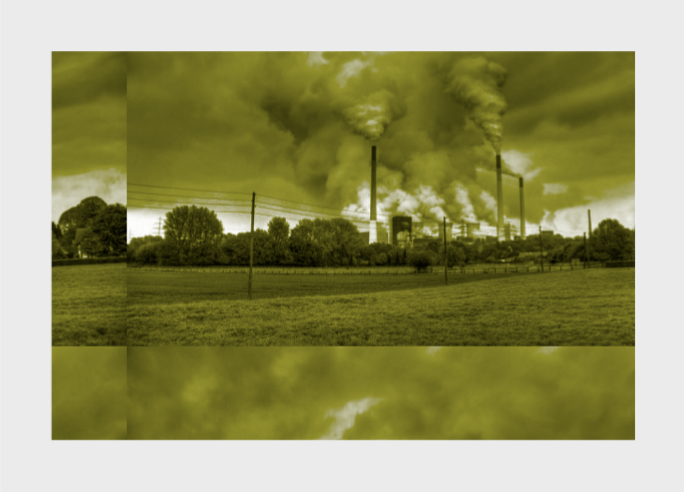
The world needs to take immediate action towards a complete phase out of fossil fuels and force global greenhouse gas emissions onto a downward trajectory. This is the clear message from the United Nations Environment Programme in its latest Emissions Gap Report. Launched today in Washington DC, the report confirms there is no time to waste if the world is to stay under the agreed red line of 2DegC average warming. The good news is that more and more countries are already waking up to this – forced to face facts by the recent government-endorsed IPCC report confirming that carbon emissions will have to be brought to zero.
The US, China and the EU have all recently showed climate action leadership: the EU with its 2030 climate and energy package; the US with its pledge to double the pace at which it will reduce carbon pollution; and China with plans to slow, peak and then reverse the course of its carbon emissions. But today’s report shows that all countries need to take action, and that deeper and faster emissions cuts will reduce climate risks and the costs of action.
Now is the moment – in the run up to the UN climate summit in Lima, Peru – for coal–obsessed blockers like Australia to show that they too wish to be on the right side of history.

Link feast
pick of the best psychology and neuroscience links from the past week or so:
Winter Is a Black Hole: How I Deal With Seasonal Depression
“Seasonal depression hits for me, like clockwork, the day after Halloween” – writes Dayner Evans at Gawker.com.
Learning How Little We Know About the Brain
By James Gorman in the New York Times.
How To Debunk Falsehoods
At BBC Future, Tom Stafford investigates the best way to correct false ideas.
The “Paper Effect” – Note Something Down And You’re More Likely To Forget It
At the Brain Watch blog I lampoon fears about the effect of computers and other digital devices on our memories.
How to Be Efficient: Dan Ariely’s 6 New Secrets to Managing Your Time
At Time magazine, Eric Barker summarises time-keeping advice from the author of Predictably Irrational.
I Hated Keeping a Gratitude Journal – Here’s What Worked Instead
Allison Jones at Fastcompany.com
Fooled By Your Own Brain
Don’t be so certain your senses are telling you the truth, says Virginia Hughes at Nautilus.
Human Body: The “Ultra-athletes” aged 60+
At BBC Future, David Robson reports on the senior ultra-athletes who are defying the limits of aging and the body.
Living With Schizophrenia
Access 60 free journal articles on this topic, courtesy of Psychology Press / Taylor and Francis.
How to Study The Brain
We’re about to obtain unprecedented amounts of new data on the brain, says Gary Marcus at The Chronicle, but the important missing ingredient is theory.
Illustrations of Madness: James Tilly Matthews and the Air Loom
At the Public Domain Review, Mike Jay recounts the tragic story of James Tilly Matthews, who was confined to Bedlam asylum in 1797 for believing that his mind was under the control of a terrifying machine.
_________________________________
Post compiled by Christian Jarrett (@psych_writer) for the BPS Research Digest.


As “Queensland premier tells Obama he is ‘solid’ on protecting Great Barrier Reef” (the Guardian), here’s a reality check…
The Abbot Point dredging project, recently approved by Australian environment minister, Greg Hunt, will allow India’s Adani Enterprises to build Australia’s biggest coal mine in the Galilee Basin in central Queensland, and dredge, to allow massive coal ships to access their proposed new shipping terminal at Abbot Point…to send coal overseas.
@ the interpretOr, we’re looking at the Indian Government’s recent report on Adani’s existing Mundra port operations that found incontrovertible evidence of:
destruction of mangroves,
blocking of creeks and…
…non-compliance of other clearance conditions.
The reporting committee, headed by Sunita Narain of Centre for Science and Environment, was set up by the Union Ministry of Environment and Forests (Government of india), to inspect ship-breaking facility of M/s Adani Port and SEZ Limited near Mundra West Port in Gujarat’s Kutch district. The committee submitted its report on April 18, 2013 and it can be downloaded in pdf by clicking here :::
Subsequently, on July 29, 2013 a public hearing for the project was held where people from four project-affected villages and nearby locations attended the public hearing at Tunda village in Mundra taluka and posed questions about the project and its impact on the environment. But the public hearing ended without the company being able to give comprehensive answers to the queries raised by the project-affected people, report Down To Earth (DTE), the Indian science and environment fortnightly:
Using remote sensing technology, the committee has found that that over the last decade, 75 hectares of mangroves have been destroyed in Bocha Island, a conservation zone. Satellite imagery indicates deterioration and loss of creeks near the proposed North Port due to construction activities. The company has also neglected to inventory its utilisation and disposal of fly ash, and has not ensured that storage tanks, seawater inlets, and discharge outlets are lined to prevent increase in salinity and contamination of water. The report also states that the Adani group has been less than serious about reporting on compliance with the conditions set at the time of clearance. In many cases, non-compliance with reporting conditions has been observed.
The committee also noted that there have been instances to circumvent statutory procedures by using different agencies, at the Centre and state, for obtaining clearances for the same project. The public hearing procedure, which is a critical part of project clearance and helps to understand and mitigate the concerns of local people, has also been bypassed on one pretext or another. The fisher community, which depends on the coasts for their livelihood, is the worst hit by the changes brought on by land acquisition and construction for the project.
(Adani project in Mundra has violated environmental norms: MoEF committee report)


The Australian government took its strategy of fighting the future to a whole new level this week, with ministers lining up to attack the ANU’s decision to abandon many of its fossil fuel investments, and Prime Minister Tony Abbott taking the coal industry’s PR line to claim that coal is “good for humanity” and has a “bright future” despite overwhelming evidence to the contrary.
We know that we cannot burn the majority of our fossil fuel reserves, the international community is preparing for a low carbon future, and it costs more to mine and ship Australian coal than it can be sold for. Couple this with China imposing a new 6 per cent coal import tariff, its steel industry being close to peak production, and forecasters saying the decline in prices will continue as China moves away from imported coal; it’s clear to see why the Abbott government’s vocal protection and support for coal has been dubbed a “suicide strategy”.
- The notion that “coal is good for humanity” ignores not only its severe impact on health, the environment and global warming, it is based on the misleading idea that it is the cheapest form of energy. Burning Australian coal willseverely increase the cost of electricity for poor Indian consumers; while in the EU onshore wind is cheaper than coal, gas or nuclear energy when external factors like air quality, human toxicity and climate change are taken into account. Prime Minister Abbott has bought into the Coal Industry’s PR offensive, but coal is not the answer to energy poverty, and no amount of “sham”, misleading PR pushes will change this.
- Tony Abbott’s declaration that coal use should go “up and up and up in the years and decades to come” demonstrates that the government has zero interest in climate action or the security threats burning fossil fuels create. It also shows just how disconnected it is from market developments and international moves towards a low carbon economy.
- The Government may want coal to be king, but the Australian people are increasingly voting with their wallets by switching to renewable power anddivesting from risky fossil fuel investments. Those impacted by fossil fuel burning are also increasingly standing up, with Pacific Islanders moving to blockade Australian coal exports, and other international protests of Australian coal firms appearing.
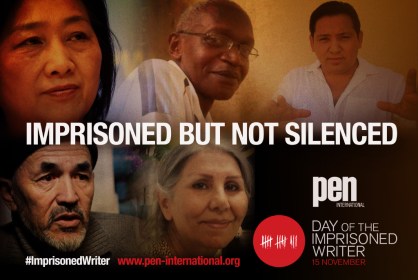
‘November 15 is a day of action and acknowledgement,’ said Marian Botsford Fraser, Chair of PEN International’s Writers in Prison Committee. ‘It is PEN’s way of saying to all of our 900 imprisoned, harassed, murdered and disappeared writers: you are not silenced. You are not forgotten. We stand with you and fight for you.’
In order to demonstrate how freedom of expression is being curtailed, each year PEN’s Writers in Prison Committee highlight five cases of writers currently in prison or being prosecuted from around the world that are emblematic of the type of threats and attacks faced by writers and journalists.
This year PEN is highlighting the cases of five writers from Cameroon, China, Iran, Kyrgyzstan, and Paraguay and calls for their immediate and unconditional release and for the charges against them to be dropped, along with all other writers similarly threatened. On 15 November, and the days surrounding, PEN Members will be sending appeal letters, raising publicity and staging events in support of their colleagues under attacks around the globe.
This year PEN International is advocating on behalf of the following writers:
Cameroon – Dieudonné Enoh Meyomesse poet, currently serving a seven-year prison sentence. PEN believes that the charges against Meyomesse are politically motivated. He is in poor health.
China – Gao Yu: journalist and member of the Independent Chinese PEN Center, she was arrested on 23 April 2014. She remains detained pending trial, and faces a lengthy prison sentence if convicted.
Iran – Mahvash Sabet: teacher and poet, is currently serving a 20-year prison sentence. She has been detained since 2008 for her faith and activities related to running the affairs of the Bahá’í religious minority in Iran.
Kyrgyzstan – Azimjon Askarov: journalist and member of Kyrgyzstan’s Uzbek minority who has spent his career exposing corruption. Sentenced to life imprisonment.
Paraguay – Nelson Aguilera: writer, teacher and member of PEN Paraguay, he was sentenced to 30 months in prison on 4 November 2014 for allegedly plagiarising a novel. Although not currently in prison as his appeal is pending, PEN is highlighting his case in an attempt to keep him at liberty.
Everyone knows about the military-industrial complex, which, in his farewell address, President Eisenhower warned had the potential to “endanger our liberties or democratic process” but have you heard of the “Deep State?”
Mike Lofgren, a former GOP congressional staff member with the powerful House and Senate Budget Committees, joins Bill to talk about what he calls the Deep State, a hybrid of corporate America and the national security state, which is “out of control” and “unconstrained.” In it, Lofgren says, elected and unelected figures collude to protect and serve powerful vested interests. “It is … the red thread that runs through the history of the last three decades. It is how we had deregulation, financialization of the economy, the Wall Street bust, the erosion or our civil liberties and perpetual war,” Lofgren tells Bill Moyers.
Climate change may not be the most obvious subject for a play, but theatregoers in London have been turning up in droves to see scientist Chris Rapley give an impressive account of the subject.
The 75-minute play, illustrated with swirling video images, manages to captivate audiences just with the power of the bare, stripped down facts of science, and without relying on the usual catastrophe imagery and doom and gloom language. “2071” discusses the consequences of mankind’s dependence on fossil fuels – how 90 per cent of the world’s glaciers and ice caps are retreating and raising sea levels. Soaring greenhouse gas levels are affecting the climatic equilibrium which is the basis of modern civilisation, says Rapley, highlighting a global temperature-rise of 2DegC as a crucial “guard rail”.
To avoid such levels of warming, “the greatest collective action in history” is required. But audiences are left with hope that with energy efficiency and a greater use of renewables such as wind farms and solar power, mankind can start to tip the balance in a better direction.


“Stop whinging, get on with it and prove them all wrong.”

While the Intergovernmental Panel on Climate Change has warned that the world must phase out up to 70 per cent of fossil fuels by 2050, Australia and other G20 nations continue to pay lip service to a clean energy transition by spending billions subsidising new fossil fuel exploration activities.
The ‘age of entitlement’ isn’t over for those filthy fossil corporations, and what’s more, we the people are subsidising them…
…A new report from Oil Change International (US) and the Overseas Development Institute (UK) has highlighted the perverse incentives governments are giving to fossil fuel companies, with G20 governments spending $100 billion (USD$88 billion) a year searching for new oil, gas, and coal reserves. The US leads the way with $5.9 billion (USD$5.1bn), but Australia’s $4 billion (USD $3.5bn) puts it a close second, and ahead of the $2.7 billion (USD $2.4bn) Russia spends.
Globally, governments subsidise fossil fuels to the tune of AUD$887 billion a year, while spending, by comparison, a tiny AUD$117bn (USD$101 bn) on renewable energy…
Such skewed support for fossil fuels is a direct threat to the global carbon budget, which states that two thirds of known fossil fuel reserves have to stay in the ground if the world is to keep average warming to 2DegC. The report urges G20 leaders to phase out these dirty, inefficient exploration subsidies as a first step to meeting existing commitments to avoid harmful climate change.
…but don’t take our word for it; here are a selection of tools and resources :::
- Report: The fossil fuel bailout: G20 subsidies for oil, gas and coal exploration(Overseas Development Institute / Oil Change International)
- Case study: Fossil fuel exploration subsidies: Australia (Overseas Development Institute / Oil Change International)
- Report: Lagging Behind: Australia and the Global Response to Climate Change (The Climate Council)
- Report: Mining the age of entitlement (The Australia Institute)
- Report: The mouse that roars: Coal in the Queensland economy (The Australia Institute)
- Report: Unburnable carbon (Carbon Tracker)
- Report: Stranded assets and the fossil fuel divestment campaign (University of Oxford)
- Report: Energy for all: financing access for the poor (International Energy Agency)
 The White House
I’m urging the @FCC to keep the internet open and free.
Here’s my plan to protect #NetNeutrality for everyone:
Obama:
“More than any other invention of our time, the Internet has unlocked possibilities we could just barely imagine a generation ago. And here’s a big reason we’ve seen such incredible growth and innovation: Most Internet providers have treated Internet traffic equally. That’s a principle known as “net neutrality” — and it says that an entrepreneur’s fledgling company should have the same chance to succeed as established corporations, and that access to a high school student’s blog shouldn’t be unfairly slowed down to make way for advertisers with more money.”



Australia is the worst polluter per capita in the Organisation for Economic Co-operation and Development (OECD), (and that is not counting the significant impact of its coal exports on air pollution and global warming, (click logo below for OECD’s spreadsheet):

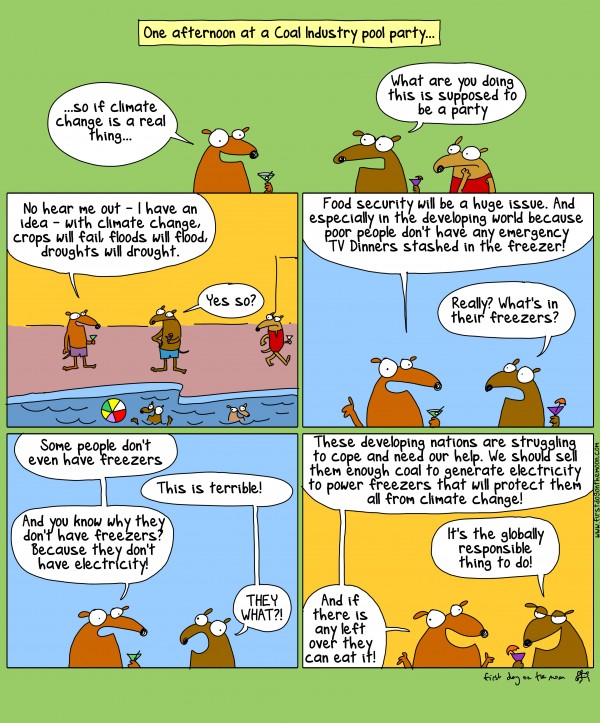
The industry and the government are ignoring climate science, and would rather pretend that coal is “good for humanity”, and sell as much of it as possible to the developing world under the guise of ending “energy poverty” when they are really only interested in keeping coal profits alive in a dying market. In fact, the World Bank has called climate change “a fundamental threat to development in our lifetime”, saying that “If we do not confront climate change, we will not end poverty.” Scientists warn that the world needs to phase out coal in the electricity sector altogether by 2050 to keep warming below 2DegC.

With ‘leaders’ (sic), puppets and stooges meeting for the G20 meeting in Brisbane this week, the role of coal in development and poverty alleviation is being relentlessly talked up, with Australian politicians from the Prime Minister down running coal industry PR lines.
However, while Tony Abbott insists that coal is the “foundation of prosperity”, a new report from The Australia Institute shows that while the industry talks a big game on fighting poverty, it doesn’t even use coal to help the energy poor in the developing world.
The report All talk, no action: the coal industry and energy poverty finds that on the few occasions coal companies have spent money to help the energy-poor, they ironically tended to use distributed, off-grid renewables or hydro power at best. At worst, G20 sponsor Peabody Coal literally did nothing to help the energy poor other than push a website and PR campaign designed to influence public policy and opinion.