Two years after NSA whistleblower Edward Snowden‘s revelations made global headlines, a new international pact for privacy rights is being launched—the Snowden Treaty, an agreement that would “curtail mass surveillance and protect the rights of whistleblowers.”
“Protecting the right to privacy is vital not just in itself but because it is essential requirement for exercise of freedom of opinion and expression, the most fundamental pillars of democracy,” the drafters—Snowden, journalists Laura Poitras and Glenn Greenwald, and Greenwald’s partner David Miranda—explain in their proposal, which will be formally introduced at a press conference on Thursday and encourages both individual citizens and global governments to sign up.
The proposal states:
- We demand for privacy on the internet.
- We demand that the government grant us the right to privacy in our homes.
- We demand that the government protect our personal privacy online.
Launched along with the website SnowdenTreaty.org, the pact is officially titled theInternational Treaty on the Right to Privacy, Protection Against Improper Surveillance and Protection of Whistleblowers (pdf).
“Signatories to the treaty will be obliged to enact concrete changes to outlaw mass surveillance. The Treaty would also develop international protections for whistleblowers,” the pact states.
Latest Entries »
News & Views | 09.18.15
Featured…
![]() |
Refugees Left Stranded As EU Faces ‘Crisis of Political Will’ by Andrea Germanos “You aren’t going to solve these problems by closing borders.” |
|
News…
![]() |
‘Foolish and Mean-Spirited’: US House Votes to Defund Planned Parenthood by Deirdre Fulton Both measures are opposed by women’s health organizations, the White House, and a majority of the American public. |
|
![]() |
Citing Abuses, US Commission Demands Release of Refugee Families by Sarah Lazare The violations are so egregious that all families should be released, detentions reduced, and alternatives to incarceration fostered. |
|
![]() |
Up 72 Perecent From Just Six Years Ago, Organic Farm Sales Soar by Nadia Prupis Americans are increasingly hungry for naturally-grown and healthier foods. |
|
![]() |
Facing South, Bernie Sanders Ramps Up Outreach in SC and Beyond by Deirdre Fulton David is rising against Goliath, with a grassroots campaign meant to increase Sanders’ exposure among minority voters in the Bible Belt and across the South. |
|
![]() |
According to New IEA Chief, Arctic Drilling Is Stupid Business by Sarah Lazare Birol’s statements come amid growing calls to place people and the planet over profit by leaving fossil fuels in the ground. |
|
![]() |
New Orleans Running ‘Modern Debtors Prison,’ Lawsuit Charges by Nadia Prupis Orleans Parish has resurrected unconstitutional “debtors’ prisons” by routinely jailing the region’s poorest residents over their inability to pay court fees and other fines. |
|
| more news… |
Views…
![]() |
Obama’s Fateful Syrian Choice by Robert Parry He can either work with Russia’s President Putin to stabilize Syria or he can opt for a confrontation that could lead to an open-ended war. |
|
![]() |
The Fed Gets It Right. Now Let’s Move to Full Employment by Isaiah Poole “The case for raising short-term interest rates is extraordinarily weak. That is not the economy we have today.” |
|
![]() |
Open Homes, Open Borders: A Dispatch from a German Village Sheltering 400 Refugees by Melody Ermachild Chavis There is no end to the long line of human beings underway tonight. |
|
![]() |
Standing With Ahmed and All Children of Color by Sonali Kolhatkar If Obama truly wants America to be great, as his tweet to Ahmed suggests, he can begin by making it a country that treats its Muslim citizens without suspicion. |
|
![]() |
Resisting the Lure of Intervention by John Feffer With each nuclear weapon, jet engine, and space rocket we deploy, we venture further into the Orange Zone, heading blindly, if not boldly, toward the point of no return. |
|
![]() |
The Republican Foreign Policy Consensus: Lunacy by Robert Borosage If you want a president to lead us into constant wars “anywhere in the world,” Republicans have your man. |
|
| more views… |
Under the Trans-Pacific Partnership (TPP), multinational corporations will be able to sue the Australian Government in secret corporate courts over laws that protect our health, environment and workers’ rights.
Australians voted for the government to run our country in the interests of the public, not corporations. Don’t let them hand sovereignty of our country over to foreign corporations.
Learn more about the TPP here: www.getup.org.au/tpp
excerpt…
That increasingly common end-of-day feeling: of physically leaving the office, only for it to tag along home. Thanks largely to technology, our availability – to clients, bosses and co-workers – extends into our evenings, weekends and even holidays. Getting a clear account of what this means for us isn’t easy, as jobs that intrude more into leisure time are also distinguished by higher pace and further factors known and unknown, making it hard to pinpoint what harmful effects, if any, are specifically due to our constant availability.
A new study published in the Journal of Occupational Health Psychology, and led by Jan Dettmers at the University of Hamburg, takes a fresh tack on this, investigating workers who have two types of free-time: on-call periods where they are free to please themselves but must remain available for potential work demands, and other periods where they are truly off-duty. For each individual participant, this set up keeps job-role demands and responsibilities equal while varying the need to be available. The data suggest that extended work availability has a negative effect: dampening mood and also increasing markers of physiological stress.
article in full + open source @ BPS Research Digest
UNHCR’s Global Trends report shows that in 2014 alone 13.9 million became newly displaced – four times the number in 2010. Worldwide there were 19.5 million refugees (up from 16.7 million in 2013), 38.2 million were displaced inside their own countries (up from 33.3 million in 2013), and 1.8 million people were awaiting the outcome of claims for asylum (against 1.2 million in 2013). Alarmingly, over half the world’s refugees are children.
“With huge shortages of funding and wide gaps in the global regime for protecting victims of war, people in need of compassion, aid and refuge are being abandoned,” said Guterres. “For an age of unprecedented mass displacement, we need an unprecedented humanitarian response and a renewed global commitment to tolerance and protection for people fleeing conflict and persecution.”
Syria is the world’s biggest producer of both internally displaced people (7.6 million) and refugees (3.88 million at the end of 2014). Afghanistan (2.59 million) and Somalia (1.1 million) are the next biggest refugee source countries.
Even amid such sharp growth in numbers, the global distribution of refugees remains heavily skewed away from wealthier nations and towards the less wealthy. Almost nine out of every 10 refugees (86 per cent) were in regions and countries considered economically less developed. A full quarter of all refugees were in countries ranking among the UN’s list of Least Developed nations…
The full Global Trends report with this information and more, and including data on individual countries, demographics, numbers of people returning to their countries, and available estimates of stateless population is available at http://www.unhcr.org/2014trends.
|
TOP STORIES THIS WEEK
|
|
Test scores tell one story, and residents tell another. A three-month investigation by In These Times reveals the cracks in the education reform narrative.
BY COLLEEN KIMMETT
A response to my critics and the case for a guerrilla war within the Eurozone.
BY SLAVOJ ZIZEK
American voters are mad as hell, and the rise of Sanders shows that they’re not going to take it anymore.
How long-time residents feel about the new Louisiana purchase.
BY FATIMA SHAIK
He also endorsed, perhaps not surprisingly, himself for the general election.
BY MICAH UETRICHT
In a post-Ferguson America, David Simon’s Show Me a Hero feels sadly dated.
BY MAYA DUKMASOVA
The fall of West Virginia’s coal mono-industry leaves the area without its peaks and forests.
BY LAURA GOTTESDIENER
|
| WORKING IN THESE TIMES |
| IKEA Says It’s “Socially Responsible.” So Why Are Workers Accusing It of Union-Busting?
A potential strike deadline is looming at one of IKEA’s largest U.S. warehouses.
BY BRUCE VAIL
|
| RURAL AMERICA |
|
When it comes to healthy eating, instant abundance has some unintended cultural consequences.
BY JOHN COLLINS
|
Senator Scott Ludlam…
With opposition to the Perth Freight Link mounting, a Senate inquiry underway and the government’s credibility crumbling, it’s time to encourage the three main companies bidding to build this toxic freeway to walk away.
The Perth Freight Link is a $1.6 billion project to construct 14km of freight freeway through our communities and bushland, including the Beeliar Wetlands.
More than 30 separate community groups are fighting to stop this incredibly expensive and unnecessary road from being built.
With mounting opposition and doubt hanging over the project it’s guaranteed that any company involved in the Perth Freight Link will face costly delays and tarnished reputations.
We’ve also produced a series of postcards to send to the tender companies. To request some postcards phone 08 9335 7477 or email aimee.smith@aph.gov.au with your postal address and the number of cards you can use.
A toxic freeway that would cause permanent and irreparable harm…
With Australia enduring the mysery of Murdoch-Minion rule, and Fox News launching Bush III out of the US, we believe that now is the time to counter the mendacious mantras of perpetual war, sacred markets and Iraq revisionism with an evidence-based reality check.
To get the ball rolling, here’s a heads up from former CIA analyst, Paul R. Pillar, via Consortiumnews.com…
“Having escaped accountability for the Iraq War disaster, U.S. neocons are urging the use of more military force in the Mideast, in line with Israeli Prime Minister Netanyahu’s demand to block the Iran nuclear deal. From their important perches of power, these war hawks also twist the history of their catastrophic misjudgments…” writes ex-CIA analyst Paul R. Pillar.
“Now the Republican presidential candidate who is the front-runner for the nomination among those whose name is not Trump has joined in the promoting of the Iraq War myth.”
Paul R. Pillar, in his 28 years at the Central Intelligence Agency, rose to be one of the agency’s top analysts. He is now a visiting professor at Georgetown University for security studies.
…banner above clicks through to podcast…
RECENT ISSUES
- Frederick Wilmot-Smith: Court Cuts
- Sheila Fitzpatrick: What Stalin Built
- Julian Barnes: Selfie with ‘Sunflowers’
- Rosemary Hill: Edward and Mrs Simpson
The author and pioneering University of Texas psychologist explains how awareness of your own thoughts and feelings can lead you to be kinder toward yourself—and why this self-compassion brings a host of mental and physical health benefits.
More about Kristin Neff.
via GreaterGood
A former CIA officer described as the latest victim of the Obama administration’s war on whistleblowers has issued a scathing open letter to civil rights groups asking, “Where were you?”…
In the letter published at the St. Louis Post-Dispatch, Jeffrey Sterling, who is black, specifically calls out the NAACP, National Action Network, Rainbow PUSH Coalition, and Congressional Black Caucus, writing “I saw you when other black faces were either killed or mistreated.” But, to these civil rights groups, he writes, he is “invisible.”
In a case that relied on circumstantial evidence, Sterling was convicted in January on nine separate felony charges, including seven counts of espionage.
He was given a 42-month sentence in May, which Norman Solomon, executive director of the Institute for Public Accuracy and coordinator of whistleblower advocacy organization ExposeFacts.org, described as “the continuation of a war on whistleblowing and journalism, to clamp down on the absolutely essential flow of information for democracy.”
::: click here or banner for piece in full @ CommonDreams :::
blurb…
Contemporary art always encompasses various disciplines. As art becomes a central part of mainstream culture in China and elsewhere, our plea is that it can contribute in a subcultural sense—not necessarily as the politically vigilant gadfly it was once imagined to be, but as a challenger of a new type. LEAP 33’s cover package “the Ends of Culture” stems from our observations on subculture. The premise is simple: rather than approaching art through cultural and conceptual matrices, we read it through its objects, artifacts, and images. In this cover package, we provide a cluster of keywords that act as a conduit towards the edge of the cultural imagination; like the catalysts and enzymes that encourage a system to grow from within, we hope to create the conditions for the creation, misinterpretation, disruption, and total collapse of an entire cognitive structure.
In addition to the cover feature’s 43 entries of subcultural keywords, this issue’s middle section includes the inaugural edition of LEAP Forum. LEAP Forum / Venice 2015: New Pavilions for a Global Asia brings together artists, curators, and other participants in projects across Venice—from the international exhibition to the national pavilions and collateral shows—to discuss and explore the rapidly changing state of Asian visual culture in the world today. Also featured are two in-depth artist profiles. Colin Siyuan Chinnery analyzes the ways artist Wang Yin incorporates Chinese avant-garde theater and modern culture into his paintings, drawing up a narrative of contemporary China’s cultural ideology and national memories. Matthew Shen Goodman offers an incisive account of recent Hugo Boss Prize winner Paul Chan’s practice, and his tongue-in-cheek attitude towards the art world.
Sea Shepherd, August 10, 2015:
The newly unveiled logo for Sea Shepherd’s Operation HenkakuThe Campaign, to be Called ‘Operation Henkaku,’ Translating to ‘Metamorphosis’ or ‘Transformation,’ Reflects Sea Shepherd’s Evolving Efforts to End the Capture and Slaughter of Dolphins and Small Whales and the Growing Global Opposition to this Brutal Hunt…
Sea Shepherd Conservation Society and its team of Cove Guardians will officially launch the sixth consecutive season of Sea Shepherd’s Dolphin Defense Campaign on Sept. 1, 2015 in Taiji, Japan. Titled Operation Henkaku (Operation Metamorphosis), preparations are underway for the campaign, during which Sea Shepherd will once again have an international team of volunteer Cove Guardians stationed along the infamous cove, documenting and live streaming the brutal capture and slaughter of dolphins and pilot whales for the world to see.
In the drive hunt conducted by the Taiji Fishermen’s Union, typically spanning from September until March, more than a thousand cetaceans are driven into the cove each year – some ruthlessly killed before the eyes of their family members and others torn away from their family pods to be sold to captive facilities in Japan or overseas. As Sea Shepherd has documented time and time again, the captive selection process occurs simultaneously to the slaughter – and the lucrative international trade in live dolphins for captivity is the economic fuel that drives the hunting boats in search of pods…
…more @ seashepherd.org
August 2015
…special report: Greece, Germany and the EU; who is a jihadi and why? North Korea, consumers on the move; gridlock in Moscow; Guadeloupe remembers slavery; Ebola, and corruption, in Sierra Leone; Frank Gehry’s monument to money; Armenian art at Venice Biennale …
|
TOP STORIES THIS WEEK
|
|
A California judge affirmed that it’s illegal to detain children, and ordered their mothers released, too.
BY JOSEPH SORRENTINO Attendees at parties across Iowa say that Bernie is “the guy we need right now.” BY DAVID GOODNER Andrew Highsmith charts the rise and fall of Flint, a city deserted by industry and divided by segregation. BY DANIEL HERTZ The cure for planned Apple-escence. BY KENDRA PIERRE-LOUIS The vision of the socialist organizer remains inspiring.
BY MAURICE ISSERMAN U.S. media commentary on the accord portrays U.S. global military supremacy as natural and desirable.
BY GREGORY SHUPAK Critics who simply claim that “Coates is no Baldwin” are ignoring what can be a comparison that allows us to understand both writers more deeply. BY ANDY SEAL On postwar anti-communist surveillance in Britain.
BY JANE MILLER Continually policing the ways women talk will further reduce them to silence. BY MAX BLUMENTHAL |
| WORKING IN THESE TIMES |
| As Nabisco Ships 600 Jobs Out of Chicago to Mexico, Maybe It’s Time To Give Up Oreos
Chicago is poised to lose 600 well-paying jobs on the city’s Southwest Side. BY MARILYN KATZ |
| RURAL AMERICA |
|
In his new climate encyclical, Pope Francis seeks to rekindle ecological consciousness. BY DAYTON MARTINDALE
|
The coal industry’s misleading attempts to brand itself as a poverty fighter continue to unravel, with a new report from Oxfam demonstrating that renewable energy is the easiest, cheapest, and most effective method to give people life-changing energy access. The Powering Up Against Poverty report shows that given its heavy health and climate impacts, coal is an ill-conceived solution to bring power to one billion people around the world and, as 84 per cent of the energy poor live in rural areas, the cost of extending electricity grids to those rural areas is prohibitively expensive. Oxfam has also warned the Australian Government – which has been aggressively parroting coal industry rhetoric – that it is time to end its love affair with coal, as it’s risking not only the global climate, but its economic and political future, given the growing emphasis on renewable energy in China, India, Africa and major economies like the US.
Renewables are the best and only choice to address energy poverty in the developing world. Oxfam notes that four out of five people without electricity live in rural areas that are often not connected to a centralised energy grid. Renewable energy solutions offer them a much more affordable, practical and healthy solution than coal. Coal’s so-called ability to lift them out of poverty is a PR exercise, as the health, climate, and economic consequences that come with coal do far more harm than good. Fossil fuels cost society US$105-$122 per tonne of carbon dioxide – two to nine times their total revenue – according to a University of Cambridge study. Companies like Peabody Energy have a net negative economic contribution to society and, as this becomes clearer, it is little wonder why the transition to clean, renewable energy is picking up steam faster than many imagined.
Climate change is hitting poor communities first and hardest, and coal is the biggest single contribution to climate change.Addressing climate change and reducing poverty go hand in hand. From an energy access point of view, renewables offer the cheapest, fastest, and healthiest way to increase energy access, which is why the world is shifting from fossil fuels to renewable energy faster than most had predicted. With its heavy environmental, health and economic impacts, coal is a major threat in the fight against hunger and poverty.
Coal is not “good for humanity”, and it’s not even good for coal companies. The changing energy landscape globally has seen coal giant Peabody Energy’s stock price sink like a stone. The company has lost just over a billion US dollars in three months, making it one of the world’s most high-profile examples of the ongoing death of fossil fuels. It may think that it can save its skin by rebranding itself as a poverty fighter but, as Oxfam notes: coal companies make heavy indirect contributions to climate change and the floods, drought, cyclones and changes to food patterns it brings. They also contribute directly through air pollution problems and displacement of communities as coal mines force them off their land, leaving them with poor access to food and water and struggling to make a living. Simply put, coal companies have no moral argument for poverty alleviation.
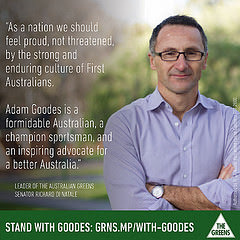
Adam Goodes is a proud Adnyamathanha man. He celebrates his Indigenous culture and calls out racism when he sees it.
We stand with him.
|
|
|
To mark the 800th year of Magna Carta, the Australian Human Rights Commission has released an animation, interactive infographic and teachers resource on the story of our freedom.
Transcript is at https://www.humanrights.gov.au/magnacarta/video/transcript.html
Animation produced by The Explainers.
|
|
|
TOP STORIES THIS WEEK
|
|
We know what politicians from the U.S. to Israel think about the Iran nuclear deal. How about asking some opponents of Iran’s regime?
BY DANNY POSTEL The rebels in Greece are waging a patient guerrilla war against financial occupation. BY SLAVOJ ZIZEK How to make Americans accept that their country was built and sustained on white supremacist plunder? Write like Ta-Nehisi Coates. BY SALIM MUWAKKIL How can we turn up the heat on Washington?
BY KATE ARONOFF A collective in Saugerties, New York, is trying to live by the teachings of 19th century Russian anarchist Pyotr Kropotkin.
BY POLLY HOWELLS For the past two years, the Crown Heights Tenant Union of Brooklyn has used collective bargaining strategies to win victories around rent control and tenant protection laws.
BY ETHAN COREY Before homes are even rebuilt in the ruins of the Gaza Strip, another war looms. BY MAX BLUMENTHAL Thanks to relentless student pressure, more than a year of rallies, protests and sit-ins proved too much to ignore. BY DAYTON MARTINDALE Corporate tax loopholes have been very effective at draining at least a billion dollars a year out of public funds and redirecting them into idle private profits. BY JAMIE MERCHANT Underneath the Laughs, ‘Trainwreck’ Is Just Another Regressive Rom Com For all its wit and unabashed vulgarity, Amy Schumer’s film follows a tired formula. BY EILEEN JONES Trump is not the only presidential hopeful willing to make utterly mind-boggling statements. BY DAVID SIROTA |
| WORKING IN THESE TIMES |
| Did ICE Violate Its Own Deportation Guidelinesin Arresting Chicago-Area Unionized Meatpackers?
ICE apprehended immigrant workers after they went on strike, even though the agency has rules against interfering in workplaces that are in the midst of labor disputes. BY YANA KUNICHOFF |
| RURAL AMERICA |
|
Conflict between New Englanders and the region’s indigenous inhabitants runs deep into history. BY DAYTON MARTINDALE
|
“To move beyond the fossil fuel era is a matter of conscience, a matter of faith and indeed, a matter of our continued existence.”
Archbishop Desmond Tutu.
|
TOP STORIES THIS WEEK
|
| The Political Genius of Bernie Sanders’ Socialism
Bernie’s socialism isn’t a “charade.” It’s a provocation-and a brilliant one, at that.
BY THEO ANDERSON To the Troika, the election of Syriza, the referendum vote and the basic principles of democracy are meaningless. BY ALEXANDROS ORPHANIDES The message being sent by the U.S. government is that when frightened women and children come to America seeking sanctuary, we will imprison them. Dr. Willie Parker is bracing for a week of potentially violent protests in his hometown of Birmingham.
BY STEPHANIE GILMORE
History will view drone warfare as the Obama administration’s signature approach to military engagement. BY MUHAMMAD IDREES AHMAD
Which campaign matters more: Bernie Sanders’ or Jill Stein’s? BY JOEL BLEIFUSS America’s most dangerous nonprofit has a stranglehold on public policy. BY SUSAN J. DOUGLAS The flag may be wiped from state grounds and license plates, but its ideals live on in the GOP agenda. BY SALIM MUWAKKIL Activists who wanted Elizabeth Warren to run for president took a poll and decided to endorse Bernie. Should other progressive organizations do the same? BY MICHAEL PAYNE The Confederate general and KKK “grand wizard” was one of the most vile white supremacists in American history. In a 5-4 decision, the court ruled that power companies can pump large levels of mercury and other toxins into the air. BY KAMIL ASHAN A coalition of farmers and vintners, doctors and lawyers, clean energy companies and reluctant do-it-yourself activists are fighting for the future of the Finger Lakes region. Despite the fact that retailers and political figures are calling for its removal, history might be too prominent for the extinction of the Confederate flag. After Greece cuts a quarter of its budget, WaPo asks if it’s willing to ‘trim spending.’ BY JIM NAURECKAS |
| WORKING IN THESE TIMES |
| Faced With I-9 Immigration Raid During Negotiations, Chicago Meatpacking Workers Walked Off the Job
Over 100 workers go on strike to protect their jobs. BY YANA KUNICHOFF |
| RURAL AMERICA |
|
The ill effects of partially hydrogenated oils are clear enough for the FDA that they will be removed from the food supply within three years. BY MAIA WELBEL
|
Irving K. Barber Learning Centre Lecture presented by the Vancouver Institute. Webcast sponsored by the Irving K. Barber Learning Centre. Naomi Klein is the author of the critically acclaimed #1 international bestsellers, The Shock Doctrine: The Rise of Disaster Capitalism and No Logo: Taking Aim at the Brand Bullies which have each been translated into more than 30 languages. She is a contributing editor for Harper’s Magazine, a reporter for Rolling Stone, and a syndicated columnist for The Nation and The Guardian.
Naomi Klein is a member of the board of directors for 350.org, a global grassroots movement to solve the climate crisis. Her new book is This Changes Everything: Capitalism vs. The Climate (September, 2014). This lecture is co-sponsored by the Canadian Centre for Policy Alternatives, 350.org and Green College.
V.S. Ramachandran, PhD is looking to solve life’s big questions by taking a different path. In studying the oddities and anomalies of the brain he hopes to illuminate the mysteries of normal brain function. A pioneer in the study of phantom limbs, Ramanchandran joins William Mobley, MD, PhD to discuss his fascinating career and his scientific process.
Elaine Chambers, a proud Kuku Yalangi/Koa Aboriginal woman from Brisbane, is this year’s winner of the prestigious National NAIDOC Poster Competition. Artists entering the competition were asked to submit an artwork which represented their interpretation of this year’s NAIDOC theme – We all Stand on Sacred Ground: Learn, Respect and Celebrate.
Ms Chambers’ artwork features four sets of feet standing on sacred ground. The most prominent set of feet are that of her father, Charlie Chambers Snr, who Ms Chambers says “hands down information to us about the sacred grounds we stand on”.
National NAIDOC Committee Co-Chair, Anne Martin, said “to me the depiction of the feet represents our families and communities standing together, strong and united on Country”.
Co-Chairs Anne Martin and Benjamin Mitchell congratulate Ms Chambers on her winning entry and thank all the talented artists who submitted their artwork in this year’s competition. “We really appreciate the work that the artists have put into their pieces.” Mr Mitchell said.
What is NAIDOC Week?
NAIDOC Week celebrates the history, culture and achievements of Aboriginal and Torres Strait Islander peoples. NAIDOC is celebrated not only in Indigenous communities but by Australians from all walks of life. The week is a great opportunity to participate in a range of activities and to support your local Aboriginal and Torres Strait Islander community.
What does NAIDOC stand for?
NAIDOC originally stood for ‘National Aborigines and Islanders Day Observance Committee’. This committee was once responsible for organising national activities during NAIDOC Week and its acronym has since become the name of the week itself.
What is the history of NAIDOC Week?
Download and print the NAIDOC History Timeline (PDF version).
::: more @ www.naidoc.org.au :::
For many shy people, online social networking sites have an obvious appeal – a way to socialise without the unpredictable immediacy of a face-to-face encounter. However, a new study finds that people who are socially anxious betray their awkwardness on Facebook, much as they do in the offline world. The researchers Aaron Weidman and Cheri Levinson said their findings could hint at ways for socially anxious people to conceal their nervousness and attract more online friends…
Believe it or not, violence has been in decline for long stretches of time, and we may be living in the most peaceful era in our species existence. Harvard psychology professor Steven Pinker presents the data supporting this surprising conclusion, and explains the trends by showing how changing historical circumstances have engaged different components of human nature.
Series: “UC Berkeley Graduate Council Lectures”
UCTV: recorded on 02/04/2014.
Current issue: July 2015
…Greece and the EU, what next? Russia re-enters the Balkans; Ukraine, inflating old fears of Russia doesn’t help; Mali, rebuilding a nation;South Africa, betrayal of a dream; radical Islam,Christianity of the poor; football, who pays for top clubs? the new Panama scandal; hooked on the Net…:
::: simply click cover to access :::
Sobriety, not austerity — Philippe Descamps
The UN’s Paris climate change conference in November doesn’t hold out much promise. Since the 1992 Earth Summit in Rio, fossil fuel consumption has gone on growing. The Green Climate Fund launched by the UN in 2011 has attracted only €10bn to date. In 2013 subsidies for fuels responsible for greenhouse gases totalled €400bn worldwide — four times the amount allocated to renewable energy sources.
Any international agreement will fail to keep global warming within 2ºC if governments insist on (…)
The 14 Defining Characteristics Of Fascism
Free Inquiry Spring 2003 5-11-3
Dr. Lawrence Britt has examined the fascist regimes of Hitler (Germany), Mussolini (Italy), Franco (Spain), Suharto (Indonesia) and several Latin American regimes. Britt found 14 defining characteristics common to each:
1. Powerful and Continuing Nationalism – Fascist regimes tend to make constant use of patriotic mottos, slogans, symbols, songs, and other paraphernalia. Flags are seen everywhere, as are flag symbols on clothing and in public displays.
2. Disdain for the Recognition of Human Rights – Because of fear of enemies and the need for security, the people in fascist regimes are persuaded that human rights can be ignored in certain cases because of “need.” The people tend to look the other way or even approve of torture, summary executions, assassinations, long incarcerations of prisoners, etc.
3. Identification of Enemies/Scapegoats as a Unifying Cause – The people are rallied into a unifying patriotic frenzy over the need to eliminate a perceived common threat or foe: racial , ethnic or religious minorities; liberals; communists; socialists, terrorists, etc.
4. Supremacy of the Military – Even when there are widespread domestic problems, the military is given a disproportionate amount of government funding, and the domestic agenda is neglected. Soldiers and military service are glamorized.
5. Rampant Sexism – The governments of fascist nations tend to be almost exclusively male-dominated. Under fascist regimes, traditional gender roles are made more rigid. Divorce, abortion and homosexuality are suppressed and the state is represented as the ultimate guardian of the family institution.
6. Controlled Mass Media – Sometimes to media is directly controlled by the government, but in other cases, the media is indirectly controlled by government regulation, or sympathetic media spokespeople and executives. Censorship, especially in war time, is very common.
7. Obsession with National Security – Fear is used as a motivational tool by the government over the masses.
8. Religion and Government are Intertwined – Governments in fascist nations tend to use the most common religion in the nation as a tool to manipulate public opinion. Religious rhetoric and terminology is common from government leaders, even when the major tenets of the religion are diametrically opposed to the government’s policies or actions.
9. Corporate Power is Protected – The industrial and business aristocracy of a fascist nation often are the ones who put the government leaders into power, creating a mutually beneficial business/government relationship and power elite.
10. Labor Power is Suppressed – Because the organizing power of labor is the only real threat to a fascist government, labor unions are either eliminated entirely, or are severely suppressed.
11. Disdain for Intellectuals and the Arts – Fascist nations tend to promote and tolerate open hostility to higher education, and academia. It is not uncommon for professors and other academics to be censored or even arrested. Free expression in the arts and letters is openly attacked.
12. Obsession with Crime and Punishment – Under fascist regimes, the police are given almost limitless power to enforce laws. The people are often willing to overlook police abuses and even forego civil liberties in the name of patriotism. There is often a national police force with virtually unlimited power in fascist nations.
13. Rampant Cronyism and Corruption – Fascist regimes almost always are governed by groups of friends and associates who appoint each other to government positions and use governmental power and authority to protect their friends from accountability. It is not uncommon in fascist regimes for national resources and even treasures to be appropriated or even outright stolen by government leaders.
14. Fraudulent Elections – Sometimes elections in fascist nations are a complete sham. Other times elections are manipulated by smear campaigns against or even assassination of opposition candidates, use of legislation to control voting numbers or political district boundaries, and manipulation of the media. Fascist nations also typically use their judiciaries to manipulate or control elections.
They Thought They Were Free
By Milton Mayer
|
TOP STORIES THIS WEEK
|
|
Sanders’s laser-like focus on inequality is perfectly insync with the nation’s current political climate.
BY THEO ANDERSON Soon the Right will have to abandon its head-in-the-sand strategy–but its next tactic may be more dangerous. BY KATE ARONOFF A hawk’s eye-view of global warming. BY TODD MILLER AND ALEX DEVOID Blumenthal offers an unembellished look at the misery on the ground in the Gaza Strip during Israel’s Operation Protective Edge in 2014. BY BEN LORBER The New York Times is wrong: consumers eating grapes and mandarin oranges aren’t the ones really guilty of contributing to California’s water shortage. BY JIM NAURECKAS Jeb Bush’s Presidential Announcement Was Simultaneously Audacious and Underwhelming Bush’s presidential campaign announcement was high on the rhetoric. Unfortunately, it was also inconsistent with everything we already know about Jeb Bush. BY DAVID SIROTA The activists behind the group are known for pranking big corporate and governmental institutions. Now they have created a tool to help others do the same. BY MICHAEL PAYNE The new black comedy about nuclear war misses its target. BY EILEEN JONES |

| WORKING IN THESE TIMES |
| Chicago Charter School Students Say UNO Teacher Was Fired for Union Activism
It’s not every day that students walk out of school to demand the reinstatement of a fired teacher–let alone one they claim was fired for helping unionize the school. BY CRYSTAL STELLA BECERRIL |
| RURAL AMERICA |
|
A new bill passed by the North Carolina Senate could prevent evidence of animal cruelty or labor violations on factory farms from ever leaving the workplace. BY DAYTON MARTINDALE
|
Glenn Greenwald, best known for his series in “The Guardian” detailing classified information about global surveillance programs based on top-secret documents provided by Edward Snowden, spoke at the University of Utah on Tuesday, April 7, 2015.